Combat Sports
Gracie Family History Maeda's Legacy and UFC's First Champion
Royce Gracie's UFC 1 victory introduced Brazilian Jiu-Jitsu. Learn how its grappling system evolved from Japanese judoka Mitsuyo Maeda to the Gracie family in.
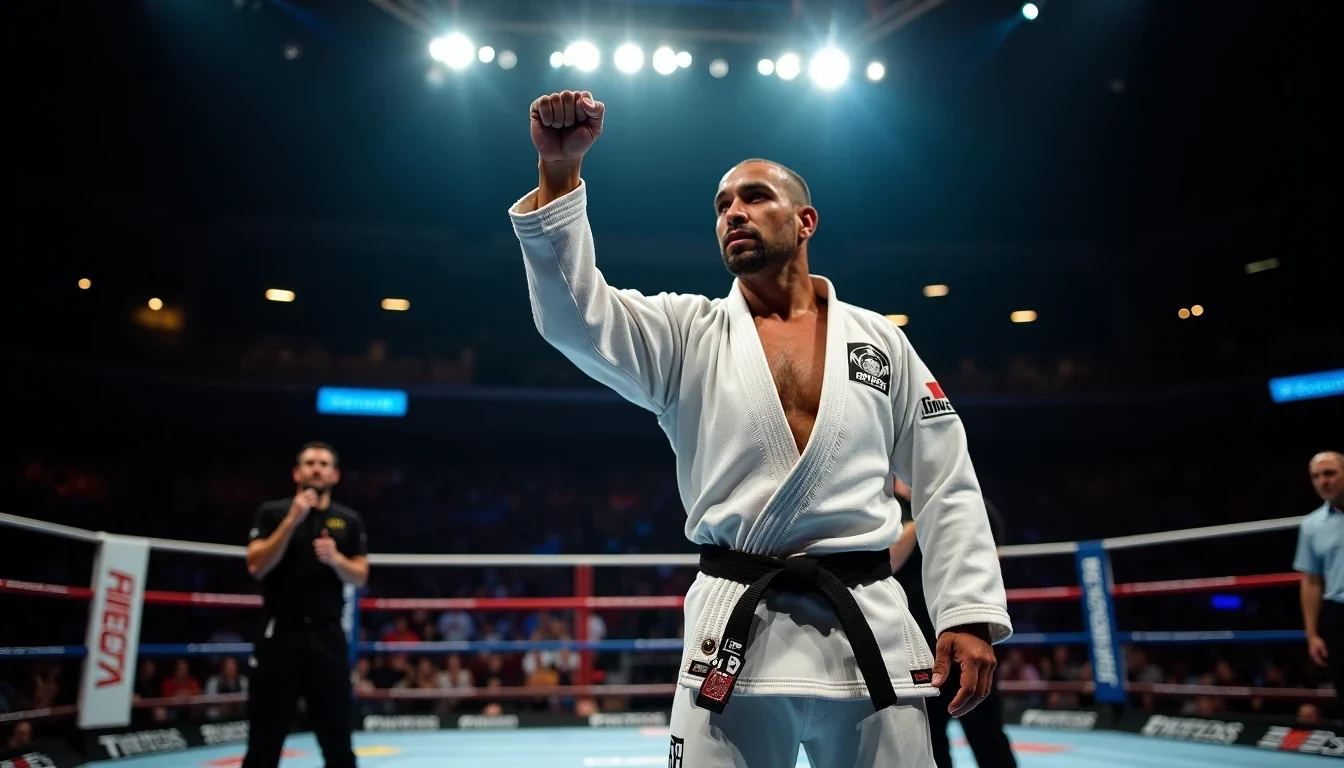
On 12 November 1993, Royce Gracie entered McNichols Sports Arena in Denver wearing a jiu-jitsu gi and weighing roughly 78 kilograms. By the end of the night he had submitted three larger men to win UFC 1. He choked boxer Art Jimmerson in 2 minutes 18 seconds. Shootfighter Ken Shamrock tapped in 57 seconds. Savate champion Gerard Gordeau fell to a rear-naked choke at 1 minute 44 seconds. The smallest fighter in the bracket had introduced North American audiences to a grappling system refined in Rio de Janeiro over the previous seven decades. That system began its Brazilian life in Belém, Pará, in July 1914, when a Japanese judoka named Mitsuyo Maeda stepped onto the dock and began teaching locals how to fall, pin, and submit.
The Judoka and the Boy in the North
Mitsuyo Maeda stepped off a steamship into Belém, Pará, in July 1914. The judoka and jujutsu practitioner, already known in wrestling posters as Conde Koma, performed challenge matches and taught grappling in exchange for local support. Gastão Gracie, a Scottish-Brazilian businessman and politician, assisted Maeda with connections and resources. As repayment, Maeda permitted Gastão’s eldest son Carlos, born in 1902, to observe his methods around 1917. Historians Roberto Pereira and Robert Drysdale still dispute how directly Carlos studied under Maeda. Some evidence points to consistent lessons; other records suggest scattered demonstrations. Carlos absorbed enough to travel south and open the family’s first martial arts academy in Rio de Janeiro in 1925, converting Maeda’s judo and jujutsu into the beginnings of Brazilian Jiu-Jitsu.
The Academy and the Weaker Brother
The Gracie academy began formal instruction in Rio de Janeiro in 1925. Carlos taught his brothers, including Hélio, born in 1913. Hélio suffered from poor health in childhood and could not generate the force needed for throws that depended on strength. He dismantled the curriculum and rebuilt it around hip movement, frames, and positional control. He argued that a smaller practitioner could neutralise a heavier attacker through efficiency rather than power. He eliminated reliance on athletic explosiveness and instead emphasised clinching, taking the fight to the floor, and controlling an opponent through superior angles. This recalibration became the defining logic of Brazilian Jiu-Jitsu. Hélio spent the rest of his life testing and teaching the art. He died in 2009, having attained a 10th-degree red belt, the highest rank the discipline awards.
No Rules and Long Nights
The Gracies spent the 1950s validating their system in vale tudo, a format with no gloves, no rounds, and almost no prohibited techniques. On 22 October 1951, Hélio faced Japanese judoka Masahiko Kimura in Rio de Janeiro. Kimura applied a reverse ude-garami arm lock that broke Hélio’s radius and forced a submission. The hold still carries Kimura’s name in every jiu-jitsu academy on earth. In May 1955, Hélio confronted a different kind of threat when he fought his former student and bodyguard, Waldemar Santana, in Rio. Santana defeated Hélio after roughly three hours and forty minutes of continuous combat, one of the longest professional fights ever documented. These brutal exchanges cemented the Gracie reputation for willingness to test technique under live fire, regardless of outcome. The violence also found a television audience when Heróis do Ringue aired from 1959 to 1960. The programme popularised the phrase vale tudo in Brazilian Portuguese, broadcasting no-rules bouts until a fighter suffered a broken arm on live television. The network then cancelled the show.
Rickson and the Televised Challenge
The challenge tradition passed to Rickson Gracie, who fought the fearsome Vale Tudo brawler Rei Zulu at Maracanãzinho in Rio de Janeiro in 1980, and again in 1984. Rickson won both bouts, demonstrating that technical control held against raw street toughness and significant weight disadvantages. A decade later, the rivalry between Brazilian Jiu-Jitsu and Luta Livre, a rival grappling style with strong roots in Rio’s wrestling gyms, demanded resolution. TV Globo broadcast the 1991 Desafio Jiu-Jitsu vs Luta Livre to a national audience. The card featured three bouts, and jiu-jitsu won all three. The clean sweep settled the stylistic debate for mainstream viewers and proved the Gracie system could win under bright lights and broadcast pressure.
Denver and the Global Stage
Rorion Gracie, Hélio’s son, had relocated to California and grown frustrated with American ignorance of his family’s art. He partnered with advertising executive Art Davie to create a tournament with no gloves, no rounds, and no weight classes. Rorion marketed the event as a style-versus-style laboratory. On 12 November 1993, 7,800 spectators filed into McNichols Sports Arena for UFC 1. Rorion hand-picked his brother Royce, the lightest and least physically imposing of the famous clan, to prove that technique outweighed muscle mass. Royce obliged. He submitted Art Jimmerson in 2 minutes 18 seconds, Ken Shamrock in 57 seconds, and finished savate champion Gerard Gordeau by rear-naked choke in 1 minute 44 seconds. Royce returned in 1994 to win UFC 2 and UFC 4, defeating larger specialists from wrestling, boxing, and kickboxing. The victories forced American martial artists to abandon the assumption that size alone decided combat. Gym enrolments in Rio and São Paulo surged as international students arrived seeking instruction.
Federations and World Championships
As American and European students began flying to Rio de Janeiro for instruction, the sport needed formal structure beyond gym challenges. The International Brazilian Jiu-Jitsu Federation formed in 1994 to standardise rules, rankings, and uniform competition formats. In 1996, the IBJJF staged its first World Championship, translating the informal blood-sport culture of the 1950s into a global circuit with weight divisions, point systems, and time limits. The first championship drew competitors from across Brazil and established the Mundial as the sport’s premier annual event. The federation now governs the competitive ladder that connects a white belt in Curitiba to a black belt in California.
Travellers today can visit Gracie Humaitá in Rio de Janeiro’s Humaitá neighbourhood, where Hélio taught for decades. The Maracanãzinho arena in the city’s Zona Norte still hosts combat sports events. Belém, for its part, hosts occasional martial arts seminars that acknowledge Maeda’s arrival, though no single monument marks the exact dock. For spectators, the IBJJF World Championship now runs annually in California, while Rio academies offer open mats to visitors who want to train where the art evolved. The lineage is physical and present, from Pará to Rio Grande do Sul, where the guard positions and chokeholds developed by Hélio are still taught daily.