Festivals
How to Experience Copacabana New Year's Eve Like a Local
Navigating Copacabana's massive New Year's Eve celebration requires careful planning to avoid crowds and transport issues.
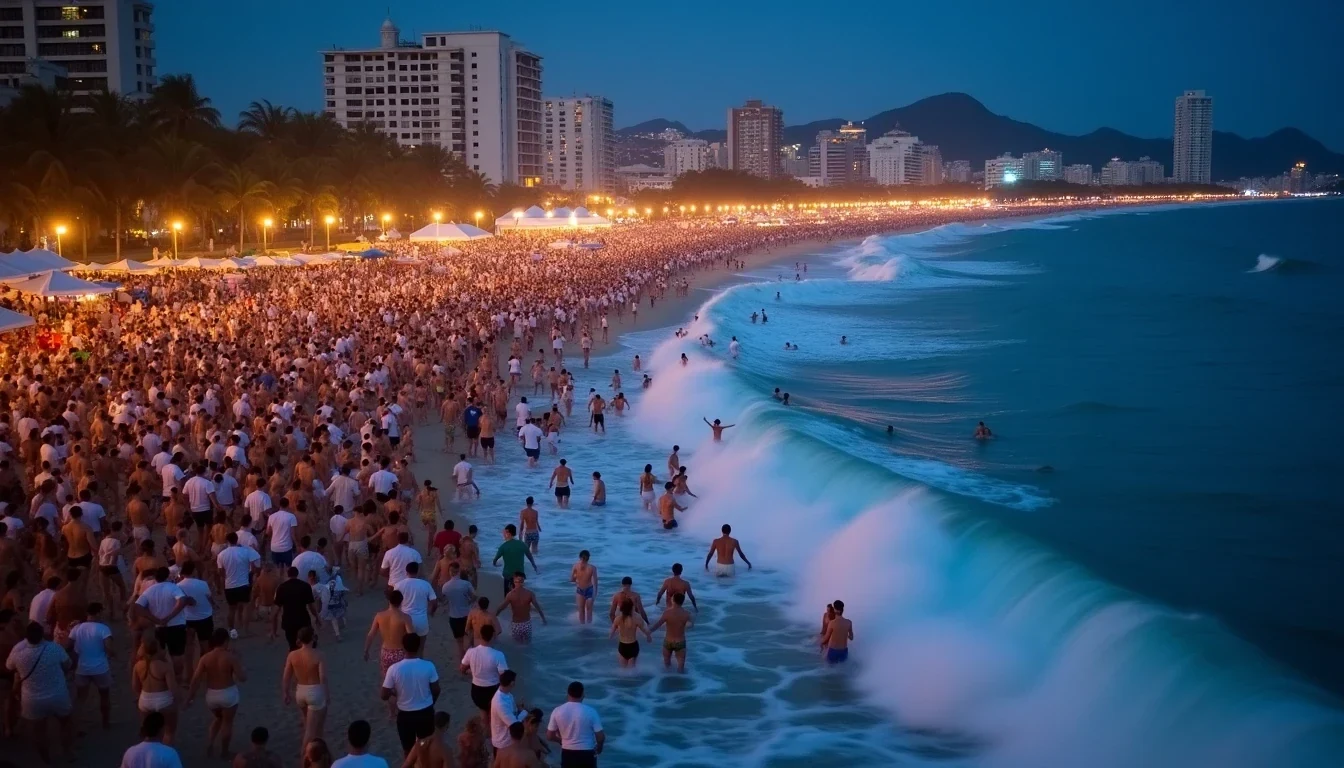
Two million people on four kilometres of sand, all dressed in white, wait for a barge to light up the bay. This is Copacabana’s Réveillon. A first-timer who arrives without a plan will spend midnight staring at someone else’s shoulders, wondering why the metro ticket they bought yesterday does not work tonight. The carioca who has avoided this for a decade knows the crowds, the heat, and the logistics of getting home through streets that belong to pedestrians until dawn. Both can have a good night. Preparation makes the difference.
What happens at midnight
The fireworks begin at 00:00 sharp and burn for twelve to fifteen minutes, launched from ten to twelve barges anchored offshore. For Réveillon 2025 into 2026, the display ran approximately twelve minutes with more than twenty tons of pyrotechnics. The 2026 into 2027 edition will follow the same scale. Riotur and the city government choreograph the show, often synchronised to a musical soundtrack announced closer to the date. The entire beach sees it, but where you stand determines whether you hear the music, feel the heat of the shells, or watch from a distance with room to breathe.
Before the sky ignites, the sand performs its own ritual. White dominates every direction, the colour of peace and new beginnings, though you will spot deliberate exceptions. Yellow for money, red for passion, blue for health, green for hope, pink for happiness. The choice is personal and public at once, a declaration of intent worn on the body. At midnight thousands run into the Atlantic to jump seven waves, one wish per jump, an offering to Iemanjá, the sea goddess of Candomblé and Umbanda. Some send flowers, candles, perfume, mirrors, riding the tide as gratitude or request. Others simply toast with whatever sparkling wine they have managed to keep cold. A minority will eat lentils before leaving home, a quieter tradition for financial luck in the year ahead.
Where to stand, posto by posto
Copacabana’s lifeguard posts, the postos, divide the beach into neighbourhoods of sand. Each offers a different transaction between atmosphere and elbow room.
Posto 1 and 2, the Leme end, sit at the northern tip nearest the Morro do Leme. The crowd thins slightly here. Families often cluster where a smaller stage sometimes hosts performances separate from the main programming. You trade the densest energy for space to sit and children who can still see the sky.
Posto 3 and 4, central Copacabana, hold the main stages and the heaviest concentration of bodies. Arrive by midday if you want a position near the water. The fireworks barges sit directly offshore here, so the visual impact is strongest, the sound loudest, and the feeling of being inside something larger than yourself most acute. This costs you proximity to strangers on every side, no escape route, and the certainty that you will not sit for hours.
Posto 5 and 6, stretching toward Arpoador and the Forte de Copacabana, give you the full sweep of the bay. The rock at Arpoador itself offers panoramic views but demands extreme patience, as space is scarce and coveted. People claim spots before noon and do not leave. Forte de Copacabana provides another vantage, slightly removed from the beach’s central crush.
Leme Beach, technically separate from Copacabana proper, runs its own smaller display and stage some years. The distance from the main barges softens the fireworks but preserves your sanity.
Rooftops along Avenida Atlântica represent the escape route for those with budget and foresight. The Belmond Copacabana Palace, Fairmont Rio, and Emiliano Rio all host ticketed parties with elevated sightlines, security, and infrastructure. Reservations open months ahead and cost significantly more than anything on the sand. The view is unmatched, but the experience is not the same ritual.
Getting there and getting home
Do not drive. Do not plan to be dropped off. Avenida Atlântica closes to vehicles from early afternoon on December 31st, around 4:00 PM based on 2025 into 2026 arrangements, and surrounding streets follow. Buses serving Copacabana reroute or suspend entirely within the neighbourhood.
Metro Rio runs the only reliable transport, operating special 24-hour service from approximately 7:00 PM on December 31st until 5:00 AM on January 1st. Regular RioCard metro passes do not work during these hours. You must purchase specific Réveillon tickets in advance, sold at metro stations and authorised points, usually colour-coded for time slots or access corridors. The 2026 into 2027 schedule will be confirmed by the city and Riotur closer to the date, but the 2025 into 2026 framework is the working assumption.
The three stations serving the beach are Cardeal Arcoverde for the northern end, Siqueira Campos for central Copacabana, and Cantagalo for the southern stretch. From any of them you will walk, through controlled corridors and then through streets given over to pedestrians, to reach the sand. Comfortable shoes are not advice; they are equipment.
Plan your exit before you arrive. The metro after midnight runs on the same special tickets, but stations compress into bottlenecks when two million people decide simultaneously that they have seen enough. Some walk toward Ipanema or Botafogo to find less congested access points. Others wait until 2:00 or 3:00 AM when the initial surge passes.
What to carry and what to leave behind
The sand is not secure. Pack accordingly.
Bring water, more than you think, in plastic bottles or a reusable container. Glass is prohibited on the beach and will be confiscated or create hazards in the dark. Light snacks sustain you through hours of waiting. A small bag worn under clothing, a fanny pack or tight cross-body, keeps hands free and thieves uninterested. Your phone, fully charged with a power bank, will have degraded mobile reception under the tower load. A light jacket or sarong for the temperature drop after midnight catches people who prepared only for daytime heat. Bring small bills in cash, nothing larger than R$50, for the vendors who sell grilled cheese skewers, caipirinhas, water, beer, and whatever else they have carried through the closed streets.
Leave valuables at your accommodation: jewellery, watches, passports, multiple cards, large cash reserves. Photocopy your passport if you must carry identification. Large backpacks mark you as carrying something worth taking. Expensive cameras draw unwanted attention. Excessive alcohol impairs judgment in an environment where judgment is your primary safety tool.
The vendors on the sand operate informal economies scaled to demand. Prices rise as midnight approaches. Quality varies. Eat something substantial before you arrive.
Safety in numbers that large
Two million people generate predictable risks. Pickpockets work the dense corridors near metro exits and the packed sand where movement is restricted. The classic distraction, a spilled drink or a staged argument, precedes the hand in your bag. Keep belongings in front of you, in physical contact with your own body.
After midnight, the crowd’s mood shifts from anticipation to release to exhaustion. This transition produces the most friction, as people move in multiple directions, some drunk, some disoriented, some simply tired of standing. Stay aware of your position relative to the water, the avenue, and the nearest exit corridor. Do not let children wander. The beach looks flat and open but compresses unexpectedly where stages, vendor concentrations, or police controls narrow movement.
Police presence is heavy and visible, but they manage crowd flow more than individual protection. Medical stations operate along the beach. Know the nearest one to your chosen posto.
Quieter alternatives for the reluctant carioca
Not everyone wants this. The carioca who has done it once and swore never again has options that preserve the symbol without the scale.
Urca, beneath the Pão de Açúcar, hosts a smaller gathering with views across the bay toward the main display. The distance reduces the fireworks to spectacle rather than immersion, but the crowd is manageable and the neighbourhood atmosphere distinct.
Paquetá Island, in Guanabara Bay, requires a ferry ride and an overnight commitment, since return boats run limited schedules. The island’s own celebration is gentle and familial, visible across the water to Copacabana’s distant glow.
Barra da Tijuca, on the city’s western edge, holds its own fireworks and beach gathering. It is smaller in absolute numbers though still substantial. The crowd skews younger, the infrastructure newer, and the transportation slightly less catastrophic.
Some simply watch from apartment windows in Flamengo or Botafogo, close enough to see the light, far enough to hear themselves think. The tradition of white clothing and midnight champagne translates to any balcony with a southern exposure.
The practical sequence
If you are going, work backwards from midnight. Buy metro tickets days before. Choose your posto based on your tolerance for density, not on some abstract ideal of the best view; they are all good. Arrive by early afternoon for central positions, by evening for the ends. Eat before you enter the beach zone. Carry water, cash in small denominations, and nothing you cannot afford to lose. Wear white if you wish, another colour if you have a specific intention, but wear something you can move in, run in, sweat in, and still feel decent at 1:00 AM. Jump the seven waves if the ritual speaks to you, or watch others do it from dry sand. Toast the new year however you toast. Then begin the long walk home, patient, hydrated, among two million others who have just done exactly the same thing, each with their own wishes still wet from the Atlantic.