Football
Brazil's Five World Cup Victories From Pelé to Ronaldo
Trace Brazil's unparalleled journey to five World Cup titles, highlighting the legendary teams, coaches, and players from 1958 to 2002.
Brazil’s national team shirt carries five stars above the crest, one for each World Cup title won across forty-four years of tournament football. No other nation has reached that number. The victories trace an arc from a teenage Pelé announcing himself to the world in 1958, through the attacking masterpiece of 1970, to Ronaldo’s redemption in 2002. Each tournament followed its own logic, its own hero, its own route through the knockout rounds. These five titles were claimed coach by coach, captain by captain, goal by goal.
The five finals at a glance
1958 in Sweden: Vicente Feola’s team, captained by Bellini, beat the hosts 5-2. 1962 in Chile: Aymoré Moreira’s side, led by Mauro Ramos, defeated Czechoslovakia 3-1. 1970 in Mexico: Mário Zagallo, the first man to win as player and coach, guided Carlos Alberto Torres’s team past Italy 4-1 at the Estadio Azteca. 1994 in the United States: Carlos Alberto Parreira and Dunga ended a twenty-four-year drought with a penalty shootout victory over Italy at the Rose Bowl, 0-0 after extra time, 3-2 on penalties. 2002 in South Korea and Japan: Luiz Felipe Scolari’s squad, with Cafu as captain, beat Germany 2-0 in Yokohama. Pelé owns three of those stars as a player. Zagallo owns three as player and coach combined. Ronaldo claimed the fifth with eight goals in a single tournament.
How Pelé announced himself in Sweden in 1958
Brazil had never won the tournament. They had lost the 1950 final to Uruguay on home soil at the Maracanã, a wound that still ached eight years later. In Sweden, Vicente Feola’s squad included a 17-year-old from Santos named Edson Arantes do Nascimento, already called Pelé, who had played only one full international before the tournament.
The knockout path built to his introduction. In the quarter-final against Wales in Gothenburg, Pelé scored the only goal of the game, controlling a ball over the defence and slotting it past the goalkeeper with a calm that belied his age. The semi-final against France in Stockholm became his announcement: a 5-2 victory sealed by a hat-trick from the teenager, with Vavá and Didi also scoring. Just Fontaine scored twice for France, but could not match Brazil’s forward momentum.
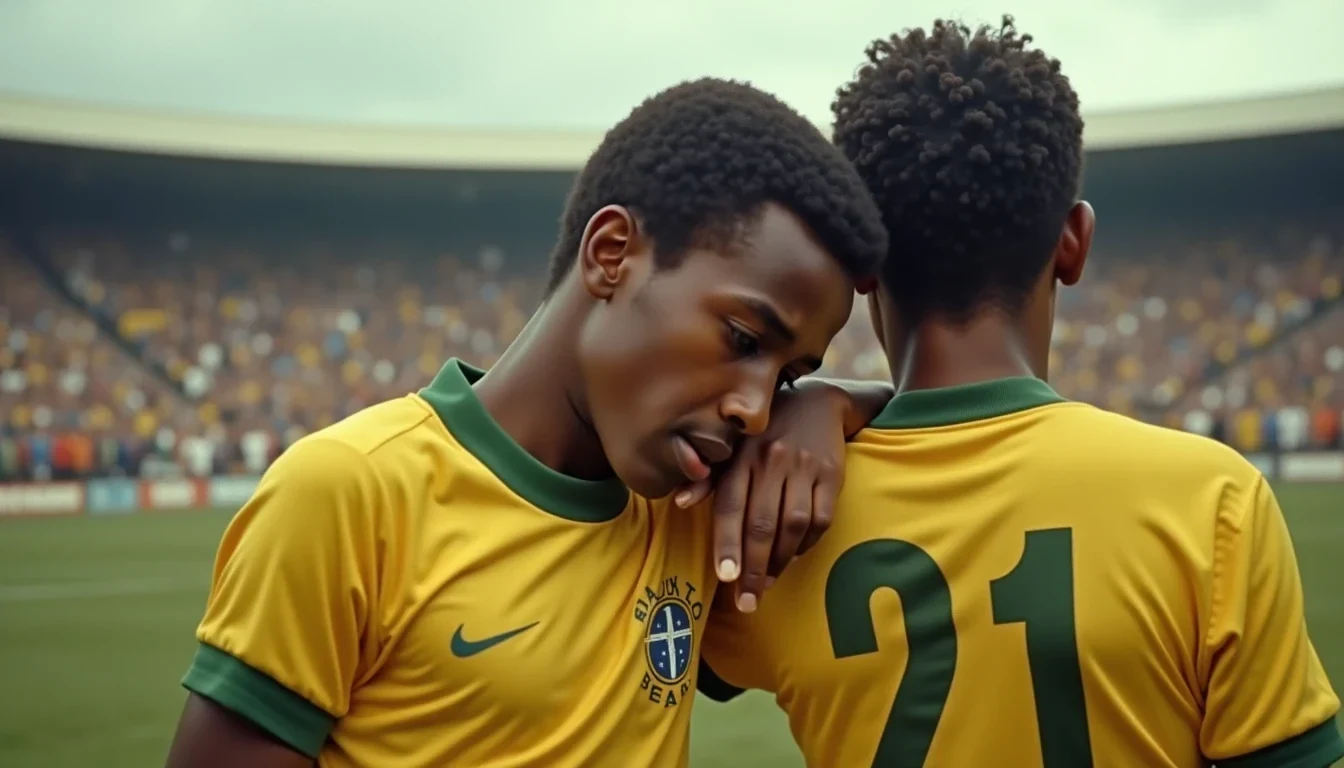
The final against Sweden in Solna on 29 June 1958 gave the world the image of Pelé weeping on the shoulder of the goalkeeper Gilmar after the final whistle. Brazil won 5-2. Vavá scored twice, Pelé scored twice, and Mário Zagallo added the fifth. Nils Liedholm had given Sweden an early lead. Bellini, the captain, lifted the Jules Rimet trophy. Pelé finished with six goals in the tournament. He was 17 years and 239 days old.
How Garrincha carried Brazil in Chile in 1962
Chile was supposed to be Pelé’s tournament too. He had scored in Brazil’s opening match, a 2-0 win over Mexico, but in the second group game against Czechoslovakia he tore a thigh muscle and did not play again. The defending champions lost their irreplaceable player with five matches remaining.
Aymoré Moreira, brother of the 1950 coach Flávio Costa, kept the team together. The captain was Mauro Ramos, the centre-back from Santos. Garrincha, the bow-legged winger from Pau Grande whose dribbling defied physics and sometimes tactical discipline, stepped forward. In the quarter-final against England in Viña del Mar, Garrincha scored twice in a 3-1 win. In the semi-final against the hosts Chile in Santiago, he scored twice more in a 4-2 victory that silenced the home crowd. He finished the tournament with four goals, sharing the Golden Boot with five other players including Hungary’s Flórián Albert, the Soviet Union’s Valentin Ivanov, and Yugoslavia’s Dražan Jerković.
The final in Santiago on 17 June 1962 pitted Brazil against Czechoslovakia again. Without Pelé, the attack was reshaped. Amarildo, Pelé’s replacement, scored the equaliser after Josef Masopust had given Czechoslovakia the lead. Zito and Vavá added the others in a 3-1 win. Vavá became the first player to score in two World Cup finals. Garrincha did not score in the final, but he had defined the tournament. Brazil had defended their title without their best player, a feat no reigning champion has matched since.
How the 1970 team won the trophy to keep
By 1970, Brazil had waited eight years. The squad that travelled to Mexico under Mário Zagallo, now the head coach after winning as a player in 1958 and 1962, is still the reference point for attacking football. Carlos Alberto Torres, the right-back from Santos, was the captain. The front five of Pelé, Tostão, Gérson, Jairzinho and Rivellino operated with a fluidity that confused markers and delighted neutrals.
The knockout rounds began with a quarter-final against Peru in Guadalajara on 14 June 1970. Brazil won 4-2, with goals from Rivellino, Tostão, and two from Jairzinho, who scored in every match of the tournament. The semi-final against Uruguay three days later in the same city brought a measure of revenge for 1950. Cláudio Taffarel, the goalkeeper, made a crucial early save from Luis Cubilla. Brazil won 3-1, with goals from Clodoaldo, Jairzinho, and Rivellino.
The final against Italy at the Estadio Azteca on 21 June 1970 was the coronation. Pelé opened the scoring with a header, Gérson added a free-kick, Jairzinho became the only player to score in every game of a World Cup, and Carlos Alberto Torres finished a move of collective genius with a right-footed drive that is still replayed more than half a century later. Italy’s Roberto Boninsegna had equalised briefly in the first half, but the second half was a demonstration. Brazil won 4-1.
The third title meant Brazil kept the Jules Rimet trophy permanently, as FIFA had decreed in 1970 for any nation winning three times. The original trophy, commissioned in 1929 and named for the FIFA president who launched the tournament, was displayed at the CBF headquarters in Rio de Janeiro. In December 1983 it was stolen from a cabinet in the CBF offices behind the Estádio do Maracanã. It has never been recovered. The replacement trophy, the FIFA World Cup Trophy, has been awarded since 1974.
How Brazil ended the drought from the penalty spot at the Rose Bowl in 1994
Twenty-four years without a title felt like a drought to a nation that had once taken success for granted. The 1982 team of Zico, Sócrates and Falcão had been eliminated by Italy in one of the great World Cup matches, but they had not won. The 1990 team fell to Argentina in the round of 16. By the time the tournament reached the United States in 1994, expectation was cautious.
Carlos Alberto Parreira, who had been Zagallo’s assistant in 1970, built a team around defensive organisation. The captain was Dunga, the midfielder from Internacional and Fiorentina, not a natural crowd favourite but an unmistakable leader. Romário was the attacking weapon, the striker from Barcelona whose finishing would decide the tournament.
The quarter-final against the Netherlands in Dallas on 9 July 1994 was the most open match of Brazil’s campaign. Romário and Bebeto gave Brazil a 2-0 lead, Dennis Bergkamp and Aron Winter pulled the Netherlands level, and Branco won it with a free-kick in the 81st minute, 3-2. The semi-final against Sweden in Pasadena on 13 July was tighter. Romário headed the only goal from a Jorginho cross in the 80th minute, 1-0.
The final against Italy at the Rose Bowl in Pasadena on 17 July 1994 was the first World Cup final to be decided by a penalty shootout. After 120 goalless minutes, the match came down to nerve and goalkeeper instinct. Franco Baresi and Daniele Massaro missed for Italy. Marcio Santos missed for Brazil. Dunga scored the decisive penalty, 3-2 in the shootout. Parreira became the second Brazilian to win the tournament as coach, after Zagallo. The twenty-four-year wait was over.
How Ronaldo scored eight goals to win it in the Far East in 2002
The 1998 final in Paris had ended in mystery and disappointment. Ronaldo, the best player of that tournament, suffered a convulsive fit the night before the match against France and played below his level in a 3-0 defeat. By 2002, questions about his fitness and his future dominated the buildup to the tournament in South Korea and Japan.
Luiz Felipe Scolari, who had won the Copa Libertadores with Palmeiras in 1999, took a squad with an attacking quartet of Ronaldo, Rivaldo, Ronaldinho and Juninho Paulista. The captain was Cafu, the right-back who had played in the 1994 final and would become the first man to appear in three World Cup finals.
The quarter-final against England in Shizuoka on 21 June 2002 produced one of the tournament’s most debated moments. Rivaldo equalised Michael Owen’s opener, then Ronaldinho scored the winner with a free-kick that drifted over David Seaman from 35 metres. Ronaldinho was sent off shortly after for a stamp on Danny Mills. Brazil held on with ten men, 2-1.
The semi-final against Turkey in Saitama on 26 June was settled by Ronaldo in the 49th minute, 1-0. The final against Germany in Yokohama on 30 June pitted Ronaldo against Oliver Kahn, the German goalkeeper who had been the tournament’s outstanding player until that match. Ronaldo scored twice in the second half, the first after Kahn spilled a Rivaldo shot, the second with a precise low finish across the goalkeeper. Brazil won 2-0.
Ronaldo finished with eight goals, the Golden Boot, and a personal redemption that completed the story of his generation. Cafu lifted the trophy. Brazil had five stars.
Brazil’s five World Cup wins
| Year | Host | Coach | Captain | Final opponent | Score | Final scorers |
|---|---|---|---|---|---|---|
| 1958 | Sweden | Vicente Feola | Bellini | Sweden | 5-2 | Vavá 2, Pelé 2, Zagallo |
| 1962 | Chile | Aymoré Moreira | Mauro Ramos | Czechoslovakia | 3-1 | Amarildo, Zito, Vavá |
| 1970 | Mexico | Mário Zagallo | Carlos Alberto Torres | Italy | 4-1 | Pelé, Gérson, Jairzinho, Carlos Alberto |
| 1994 | United States | Carlos Alberto Parreira | Dunga | Italy | 0-0 (3-2 pens) | , |
| 2002 | South Korea/Japan | Luiz Felipe Scolari | Cafu | Germany | 2-0 | Ronaldo 2 |
The shirt with five stars is still the only one in international football to carry that number. Italy and Germany have four each. Argentina, after 2022, has three. The gap may close or widen in future tournaments, but the record belongs to Brazil alone for now.