American Football
Copacabana Beach Football Brazil's American Football Origin
American football in Brazil originated on Copacabana beach in 1986, with early players improvising equipment and rules due to a complete lack of local supplies.
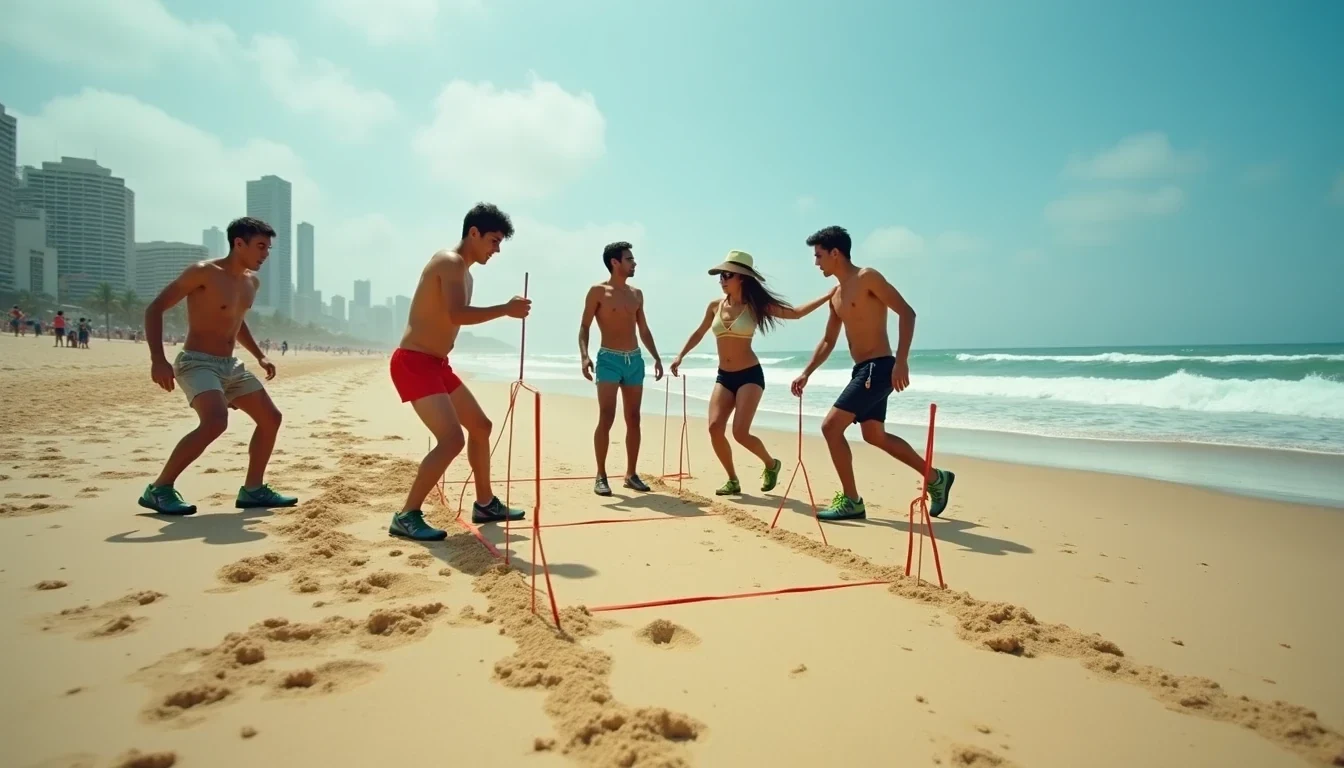
American football in Brazil did not begin on a manicured grass field with shoulder pads and goalposts shipped from Texas. It started in 1986 on Copacabana beach, where Robert Segal and Thomaz Brasil gathered roughly eighteen friends for games played in swimwear and borrowed sneakers. Segal had carried a single football back from the United States. Mouthguards came from ordinary sports shops in Rio. For the next fifteen years, no store in the city stocked American football equipment, so every subsequent ball arrived through internet orders or the luggage of friends returning from trips abroad.
The sand imposed its own logic. Without helmets or pads, full contact was impossible, so the group restricted hitting and adapted the hardware around them. Traditional Y-shaped goalposts, unstable in beach wind, gave way to simpler H-shaped frames that could be driven into the sand. Nylon tape, not chalk, marked the boundaries and yard lines. These were survival mechanisms for a sport with no supply chain, no governing body, and no local precedent.
By 1999 the scattered games had coalesced into something more structured. The Carioca Bowl launched that year as an annual tournament running from July through December across Rio’s beaches. It gave teams a fixed calendar, a championship to chase, and a reason for players beyond the original Copacabana circle to commit. The event spread the sport to Ipanema, Leblon, Barra da Tijuca, and beyond. By 2006 American football was being played on thirteen beaches across Rio de Janeiro state, and the Associação de Futebol Americano do Brasil (AFAB) had registered approximately six hundred athletes. Early television coverage on Bandeirantes, however sporadic, fed curiosity among viewers who had never seen a down played on Brazilian soil.
The Beach Soccer Squeeze
The expansion collided with another beach sport’s rise. From 1995 onward, municipal authorities and private operators began converting Copacabana pitches to beach soccer dimensions. The resulting fields were too compact for American football’s width and depth. Where players had once set up H-posts and nylon tape, they now found goals and boards meant for a different game. The squeeze was physical and administrative: fewer usable strips of sand, more competition for morning and evening time slots, and no institutional leverage for a sport still operating outside formal recreation frameworks.
The migration to grass was inevitable but not immediate. Players who had learned the game on sand wanted the full-contact version they had watched on NFL broadcasts, the version that required helmets, shoulder pads, and cleats on a regulation field. The move allowed standard rules, proper equipment, and integration with international structures. It also severed the sport from its founding environment. By the early 2000s, organized American football in Brazil was becoming a grass-field enterprise, practiced on municipal athletics tracks and rented soccer pitches, with imported gear finally available through specialized retailers.
What Survived on the Sand
The beach format did not disappear. It evolved into flag football, a non-contact variant that preserves the tactical core of American football without the collision physics that sand resists. Beach flag championships continue today, particularly in Rio, where the sport’s origins give it cultural weight that other cities cannot replicate.
Vasco da Gama’s women’s team has dominated this scene recently, winning consecutive Beach Flag titles against established competition. The club’s program, rooted in Rio’s beach football heritage, has become a pipeline for talent and visibility. On the full-contact side, Vasco Almirantes reached the 2026 Sudeste final of the national Superliga, the top tier of Brazilian American football. The result confirms that Rio clubs, despite the sport’s migration inland, remain competitive at the highest domestic level.
Visiting the Origin
For travelers in Rio, the physical traces are subtle but present. Copacabana’s postos still host morning athletic gatherings, though beach soccer and footvolley now occupy the marked pitches where American football began. The Carioca Bowl era left no permanent monument, no bronze plaque at Posto 5 or 6. The legacy lives in club names, in the H-posts still used for informal flag games, and in the oral history passed between players who remember ordering their first balls from US catalogues and waiting weeks for delivery.
Visitors interested in catching a game should check schedules for the Superliga season, which runs roughly March through November, with ticket prices typically between R$ 20 and R$ 60 as of 2024 depending on venue and fixture. The Sudeste conference, covering Rio and São Paulo, offers the densest concentration of matches. For beach flag, the calendar is more fragmented, but social media feeds of clubs like Vasco’s American football division announce tournaments and open sessions, often on weekend mornings when Copacabana’s sand is firm and the crowds thin.
The sport’s Brazilian vocabulary still carries its beach origin. Players speak of “praia” formations and sand drills as foundational training, even on grass. Equipment remains expensive, a lingering effect of the import-dependent early years. A basic helmet and pad set runs R$ 1,500 to R$ 3,500 as of 2024, and league fees add several hundred reais per season, costs that push the sport toward middle-class participants in a way the original beach games did not.
American football in Brazil will never again be what it was in 1986: twenty people, one imported ball, and the improvised rules of a sport no one else on the beach recognized. That condition was unrepeatable by design. But the current structure, with national leagues, televised finals, and women’s teams winning consecutive championships, grew directly from those mornings on Copacabana. The sand taught Brazilian players how to adapt, how to organize without resources, and how to build a sport from whatever the luggage carousel delivered.