Stories
Amyr Klink's 100 Days The Real Atlantic Crossing Story
In 1984, Amyr Klink rowed alone across the South Atlantic in a plywood boat for 100 days, turning an ignored journey into a celebrated feat that endures today.
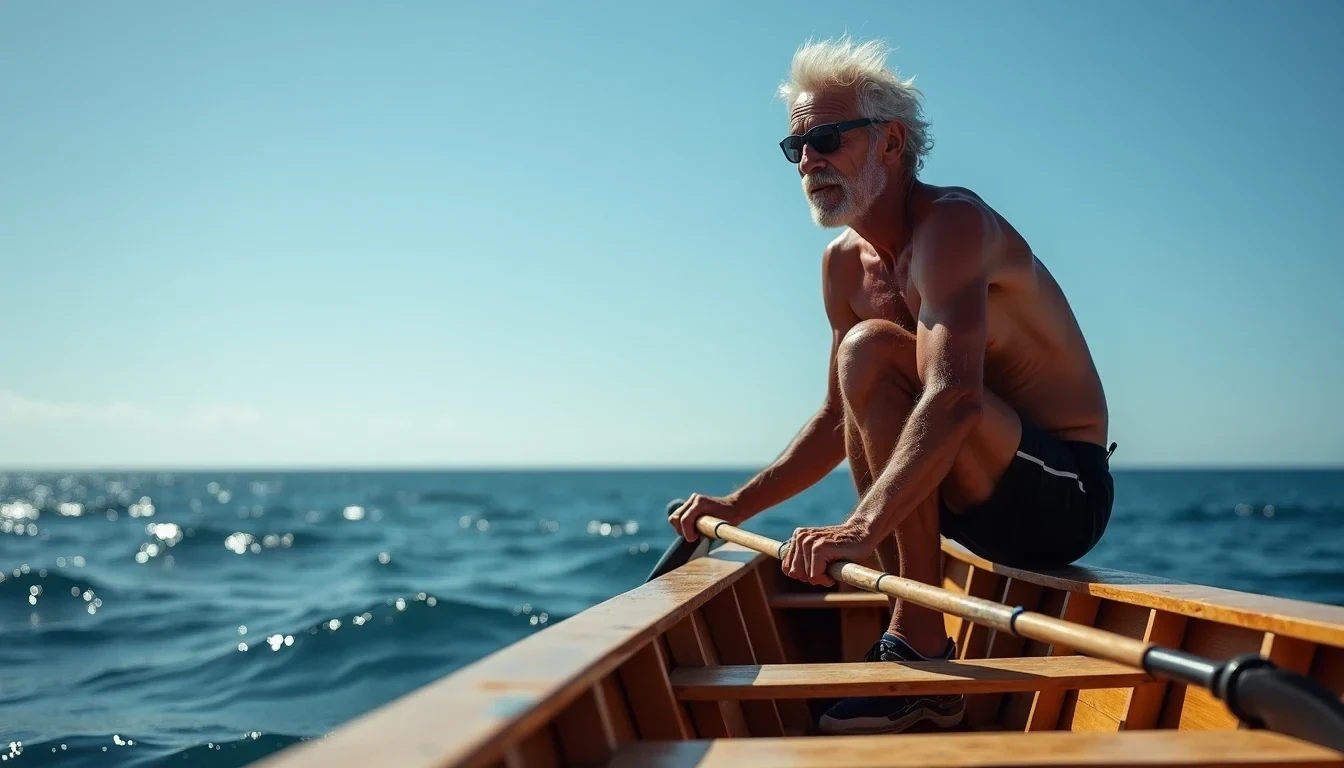
The first person to row alone across the South Atlantic left shore with almost nobody betting he would survive. Amyr Klink, twenty-eight, built a plywood boat in a shed and set out from a Namibian fishing town with supplies for three months and no support vessel trailing behind. When he reached the coast of Bahia 100 days later, the same newspapers that had ignored his departure ran front pages asking who this man was. That was October 1984. Four decades on, his book still sells, his hometown still keeps his boats, and a major film is about to introduce him to viewers who have never pulled an oar.
The boat that had to be smarter than its builder
Klink named the vessel IAT, three letters with multiple meanings. Some read them as “International Atlantic Transit.” Others heard the Tupi-Guarani word for earth, the planet he was trying to cross under his own power. The boat measured just 5.9 meters from bow to stern, roughly the length of two parked cars. He built it from plywood and fiberglass with help from friends, optimizing for self-righting capability and watertight storage, qualities that mattered more than speed.
The self-righting feature was not theoretical. The South Atlantic throws rogue waves that can flip small craft end over end. Klink’s hull was weighted and shaped so that if a wave stood the boat vertical, gravity would pull it back to level before the next wave arrived. Watertight compartments held his food, fresh water, and the navigation equipment that told him where the currents were pushing him. The rowing station was positioned for maximum efficiency over thousands of hours, not for comfort. There was no cabin to stand in, no berth to stretch out on. For 100 days, the boat was his entire world.
What 100 days alone actually means
Klink pushed off from Lüderitz, Namibia, on 10 June 1984. He made landfall at Praia da Espera in Itacimirim, Bahia, on 18 September, then continued to Salvador. The straight-line distance between his start and finish points runs about 6,500 kilometers. Sources vary between 3,200 and 3,500 nautical miles depending on whether they measure to Itacimirim or Salvador, and whether they account for the looping path the currents forced on him.
Those currents were characters in the journey, not background. The Benguela Current flows northward along the African coast, pushing Klink away from his destination for his first weeks at sea. Further out, the South Equatorial Current runs westward across the Atlantic, helping him once he fought far enough into open water to catch it. His actual track traced a curve, not a line, adding distance that no map projection captures cleanly.
The physical load was relentless. Rowing twelve to fourteen hours daily against or across the current left him in a state of permanent fatigue. Sleep came in fragments, never deep enough to recover. He had to maintain the boat, repair what broke, navigate by sun and stars when electronics failed, and ration food and water against the possibility that the crossing would take longer than planned. Sharks and whales passed beneath a hull too thin to offer any real protection. Equipment failure anywhere on that curve meant no rescue. No radio call would bring help in time.
The psychological load ran parallel. Three months without human voice, without touch, without any stimulus except the horizon and his own thoughts. Klink later described moments of hallucination, of talking aloud to maintain the sound of language, of forcing structure onto days that wanted to dissolve into sameness. The book he wrote captures this not as heroism but as arithmetic: hours divided into shifts, calories divided into meals, will divided into mornings when quitting would have been easier than continuing.
The book that outlived the achievement
Cem Dias Entre Céu e Mar appeared in 1985, one year after the landing. It sold more than 300,000 copies in Brazil, extraordinary numbers for a first-person account of physical endurance by an author nobody had heard of three years earlier. The prose is direct, almost spare, built from the daily logs Klink kept in waterproof notebooks. He recorded weather, position, physical condition, and the stray observations that isolation sharpened: phosphorescence on night water, the particular silence of a windless afternoon, the way fear and boredom could occupy the same hour.
The book’s influence extended beyond the adventure readership. It became a reference point for discussions about Brazilian capability, about what a young man from a small coastal town could attempt without institutional backing. Klink had been dismissed before the crossing, written off as unrealistic by people who later claimed to have always supported him. The book let him set the terms of his own story, and readers responded to the absence of boasting. He described what he did, what broke, what he fixed, and what he thought about while doing it. The philosophical passages read as earned, not imposed.
From the Atlantic to the poles
The South Atlantic row established Klink’s method: design the tool, train the body, accept the solitude, and document everything. He applied it to larger stages. In 1989 he departed on the Paratii, a sailboat named for his hometown of Paraty, on an expedition that would last 642 days and carry him from Antarctica to the Arctic. The “Between Two Poles” journey made him the first Brazilian to sail from one polar region to the other. This route demanded ice navigation, seasonal timing precise enough to catch narrow windows of open water, and the same tolerance for isolation extended across nearly two years.
A decade later, in 1998 and 1999, he returned to Antarctica for an 88-day solo circumnavigation of the continent aboard the same Paratii. This was not a race against competitors but against the southern winter, against the ice that closes in, against the mechanical failures that find small boats in the highest latitudes. He completed it. By then he had spent more of his life on expeditions than off them, and had built a readership that followed his movements the way others follow sports seasons.
Where the film meets the record
Carlos Saldanha’s 100 Dias, starring Filipe Bragança as Klink, opens in Brazilian cinemas on 29 October 2026. Saldanha has directed animated features that reached global audiences. This is a different scale, a historical drama built around one actor in a small space pretending to endure what one man actually endured. The core facts are fixed: the dates, the boat, the route, the achievement. The film will invent the texture of daily life, the dialogue Klink spoke with no one, the emotional beats that turn a logbook into a narrative.
Viewers who want the unfiltered account should read Cem Dias Entre Céu e Mar first, or after, or both. The book offers no score to tell you when to feel tension. It offers the weather on day forty-seven, the repair made to an oar lock with materials carried for exactly that purpose, the calculation of remaining water. The film will give you a face to put with the name. The book gives you the mind that planned the journey and the body that executed it.
How to engage with the legacy now
Paraty, in Rio de Janeiro state, remains the anchor. Klink grew up there and still keeps his boats in the harbor where he learned to handle small craft before he tried crossing an ocean in one. The town is accessible by bus from Rio, roughly four hours on the Costa Verde route, or by private transfer. Visitors walking the colonial center pass the water where the Paratii was prepared, though nothing marks the specific slip. The house where Klink lived is not a museum. The engagement is looser, more atmospheric: understanding that this harbor produced someone who looked at the South Atlantic and decided it could be crossed by muscle alone.
For readers approaching Cem Dias Entre Céu e Mar in 2026, the book functions as both historical document and practical meditation. The navigation details are dated, the equipment superseded. The problem of structuring long solitude, of maintaining function when every external support has been removed, remains current. Remote workers, solo travelers, and anyone who has spent unexpected days alone in unfamiliar conditions will recognize parts of Klink’s method even if their own stakes are lower.
The film will bring new attention. Some viewers will search for the book, some will search for Paraty, some will search for the distance between Namibia and Brazil and try to imagine covering it at rowing speed. The ones who follow through on any of these searches will find that Klink’s achievement has aged into something more interesting than a record. It is a case study in what happens when preparation meets refusal to quit, when the dismissals of others become data rather than discouragement, and when a 5.9-meter boat built in a shed becomes the vehicle for a national story.