Stories
Henry Ford's Amazon Ghost Town Fordlândia Lives On
Henry Ford's ambitious plan to grow his own rubber in the Amazon to escape foreign monopolies led to a $20 million failure, creating a legendary jungle ghost.
Henry Ford never set foot in the jungle town that still carries his name. That single fact captures the absurdity of Fordlândia better than any summary. A man who micromanaged every bolt and wage in Detroit’s River Rouge Plant and inspected factory floors with a jeweler’s loupe delegated his Amazon empire to deputies and annual reports. The result was a $20 million lesson in what happens when industrial arrogance meets a rainforest that refuses to industrialize.
The Rubber Kingdom That Never Was
By the 1920s, Ford Motor Company consumed more rubber than almost any enterprise on earth. British and Dutch plantations in Malaya controlled the global supply, adjusting prices at will. Ford, who already owned iron mines and glassworks to escape middlemen, decided he would grow his own latex. In 1928 his representatives struck a deal with Dionísio Bentes, governor of Pará, securing a concession of roughly 10,000 square kilometers along the Tapajós River. The territory was larger than some European nations.
The first ships arrived that same year carrying not just tools and machinery but the complete physical vocabulary of American small-town life: prefabricated bungalows, hospital equipment, a 50-meter water tower, even doorknobs. Albert Kahn, the industrial architect behind Detroit’s most iconic factories, designed the buildings. Paved streets grid the clearing. Workers laid out a golf course, built a cinema, and installed ice machines. Ford intended to reproduce Michigan in the Amazon, right down to the diet. Workers would eat hamburgers, oatmeal, and canned peaches whether they wanted to or not. Alcohol was banned. Prohibition, that failed American experiment, would be enforced by company police twelve degrees south of the equator.
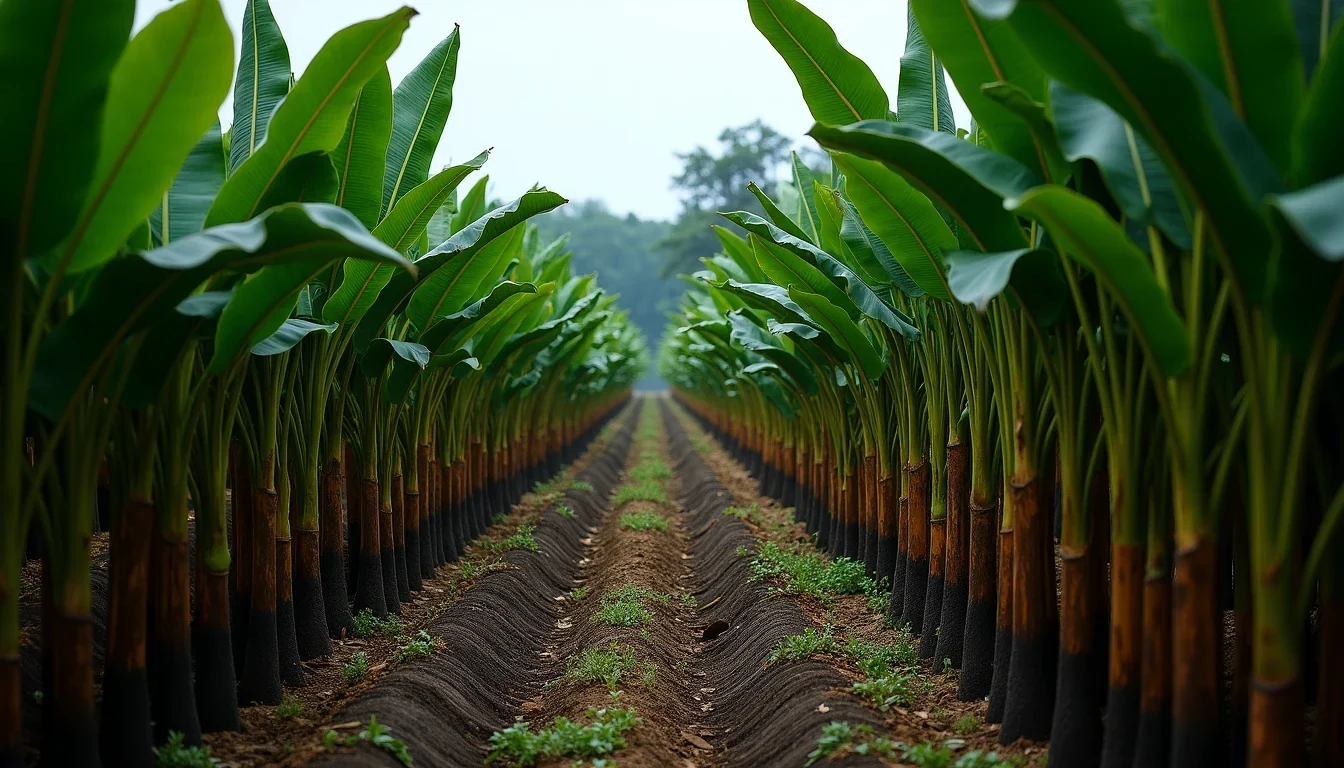
The agricultural plan matched the cultural program in its rigidity. Engineers planted rubber trees in tight, orderly rows, as if arranging machine parts. They chose hilly ground that drained poorly and offered little of the rich alluvial soil rubber needs. Monoculture on this scale was already suspect. Packing the trees together turned suspicion into catastrophe. South American leaf blight, Microcyclus ulei, spread through the plantation like a rumor. Pests arrived in waves. The forest, which had spent millennia developing checks and balances against such outbreaks, offered no resistance to this artificial concentration of host plants. Yields collapsed before they had properly begun.
The Revolt of the Broken Pots
The environmental failure might have killed Fordlândia eventually. The workers ensured it happened faster. In 1930, a rebellion erupted that Brazilians still call the Quebra-Panelas, the Pot-Breaking. The immediate trigger was food: specifically, the American menu imposed on laborers accustomed to rice, beans, farinha, and fish. Ford’s managers served oatmeal and canned meat at regimented hours, treating Brazilian workers as defective Americans rather than people with their own established lives.
The revolt began in the workers’ kitchens and spread within hours. Men smashed the imported crockery that gave the uprising its name. They cut telegraph wires, isolating the settlement from Santarém and Belém. American managers fled into the forest or were driven onto boats. Order returned only when Brazilian military forces arrived to impose it. The Quebra-Panelas was a rejection of the entire premise that Ford’s industrial civilization could be transplanted without negotiation, adaptation, or respect.
Ford’s operation limped forward for four more years. In 1934 the company admitted partial defeat, shifting its remaining rubber ambitions downstream to Belterra. The new site sat on a plateau with better drainage and less hostile soil. Agronomists experimented with grafting disease-resistant rootstock. These were genuine improvements, lessons wrested from failure. They were also too late. By the 1940s synthetic rubber, developed partly in response to wartime supply disruptions, made natural latex cultivation economically marginal for Ford’s purposes. Henry Ford II, who had inherited his grandfather’s empire without his micromanaging temperament, sold the land back to Brazil in 1945. The loss exceeded $20 million in contemporary dollars, roughly a quarter-billion today. The founder had died two years earlier, still without having seen the jungle outpost that bore his name.
The Town That Refused to Die
Fordlândia should have finished as a curiosity, a few rotting buildings swallowed by vines. For a while it looked like that would happen. The population bottomed near ninety souls, scattered among structures built for thousands. The forest advanced on the American Village. The hospital, once the most advanced medical facility between Belém and Manaus, stood empty.
Then people began returning. Not as Ford’s employees, but as settlers claiming the infrastructure a dead empire had left behind. The water tower, that 50-meter American import, still draws and distributes water. Warehouses, the sawmill, the machine workshop, all serve functions their builders never imagined. Some bungalows house families three generations removed from anyone who worked for Ford. The hospital did not survive intact. Looters stripped it in the late 2000s, leaving a shell that still dominates the town’s skyline like a concrete warning.
Today Fordlândia functions as a district of Aveiro, a municipality of roughly 3,000 people where 90 once huddled. The population curve says something about Amazonian settlement that Ford’s accountants never understood: people here adapt, persist, and find value in what outsiders discard. The town’s current residents fish, farm small plots, harvest Brazil nuts and açaí, and trade up and down the Tapajós. They live with the ruins rather than in them, incorporating concrete American ghosts into a Brazilian present.
How to Get There
Reaching Fordlândia requires accepting river time. The settlement sits approximately 300 kilometers up the Tapajós from Santarém, and no road bridges that distance. Boats leave Santarém’s port with schedules that shift according to cargo, water levels, and the captain’s judgment. Travelers should confirm departure times in person, build buffer days into their plans, and bring cash, mosquito repellent, and tolerance for uncertainty.
The journey itself offers compensation. The Tapajós runs clear and coffee-brown by turns, depending on which tributary has recently fed it. Dolphins surface near the bows of slower boats. Forested banks give way to occasional clearings, then return. After twelve to eighteen hours depending on vessel and current, Fordlândia appears as a sudden geometry of right angles against the organic confusion of the shore.
Accommodation in town is basic. Do not expect boutique pousadas or guided heritage tours. Visitors sleep in simple guesthouses or arrange homestays through local contacts. The reward is access without performance: a place where history remains physically present but commercially unexploited, where you can stand in Albert Kahn’s architecture while children kick a football against walls built for Model T executives.
The Belterra Counterpoint
Most travelers who commit to the river route continue, or detour, to Belterra. Ford opened this second plantation in 1934 as a corrected draft of his original vision, and the contrast illuminates both sites. Fordlândia clings to hills that defeated it; Belterra spreads across a plateau with natural drainage. The first settlement imposed American forms wholesale; the second incorporated at least some agricultural lessons: wider spacing between trees, experiments with resistant cultivars, and a grudging acknowledgment that the Amazon would not simply comply.
Belterra also survived its corporate parent more gracefully. The town developed a sustainable rubber economy through the 1950s and 1960s, long after Ford’s departure, and maintains a more coherent historical center. Visiting both settlements in sequence, a two or three-day river circuit from Santarém, offers the full narrative arc: ambition, correction, partial adaptation, ultimate failure, and the stubborn persistence of people who outlasted the industries that tried to organize their lives.
What Remains
Fordlândia’s most honest monument may be the water tower, still functioning after nearly a century. It embodies the paradox of the entire venture: American engineering robust enough to survive, American planning arrogant enough to fail. The tower was built to serve a rubber empire. It now serves subsistence farmers and fishers who have never owned a Ford vehicle.
The town offers no comfortable moral. Environmental historians can cite it as evidence that monoculture and rainforest are fundamentally incompatible. Labor scholars can frame the Quebra-Panelas as early resistance to corporate colonialism. Travelers can photograph the decaying bungalows and feel pleasantly melancholic. All these readings are partially true. None quite captures the strangeness of standing in a Michigan street grid while howler monkeys argue in the canopy overhead.
Henry Ford’s absence from his namesake town was characteristic. He controlled through systems, through manuals, through the assumption that human behavior could be standardized like piston tolerances. Fordlândia proved otherwise. The Amazon taught what Detroit could not: that soil, disease, appetite, and dignity resist efficient management. The lesson cost $20 million and change. The town, improbably, survived the tuition.