Combat Sports
Brazil's Boxing Champions From Popó to Olympic Gold
Brazil's boxing prowess, often overshadowed by MMA, is deeply tied to Salvador, Bahia.
Brazil punches above its weight in combat sports, but the story usually starts and stops with MMA. Wanderlei Silva, Anderson Silva, Amanda Nunes, Alex Pereira. Brazil’s boxing record runs deeper, with two Olympic golds, a four-time world champion, and a single city that keeps producing fighters who climb out of poverty and onto podiums. That city is Salvador, Bahia, and its most famous export in gloves is Acelino “Popó” Freitas.
Popó was born on 21 September 1975 in Salvador. He turned professional in 1995, the same year he won silver at the Pan American Games in Mar del Plata, Argentina. Four years later, on 7 August 1999, he flattened Anatoly Alexandrov in the first round to claim the WBO super featherweight title. The knockout came fast and brutal, building his reputation in seconds. He defended that belt repeatedly before unifying the division on 12 January 2002, outpointing Cuba’s Joel Casamayor over twelve rounds to add the WBA strap. He moved up to lightweight, winning a third belt on 3 January 2004. Artur Grigorian, the longtime WBO lightweight champion, lost every round on the cards. Popó held the belt until 7 August 2004, exactly five years after his first title win, when Diego Corrales stopped him in Las Vegas. The loss was a shock, but his career continued. On 29 April 2006, Popó decisioned Zahir Raheem for the vacant WBO lightweight title, his fourth world championship. He lost it for good to Juan Díaz on 28 April 2007, stopped in the eighth round in Connecticut. His final record reads 41 wins, 2 losses, 34 knockouts. After retirement, he served as a state deputy for Bahia from 2011 to 2014. He still makes occasional exhibition appearances, though his competitive chapter closed long ago.
Salvador’s second son
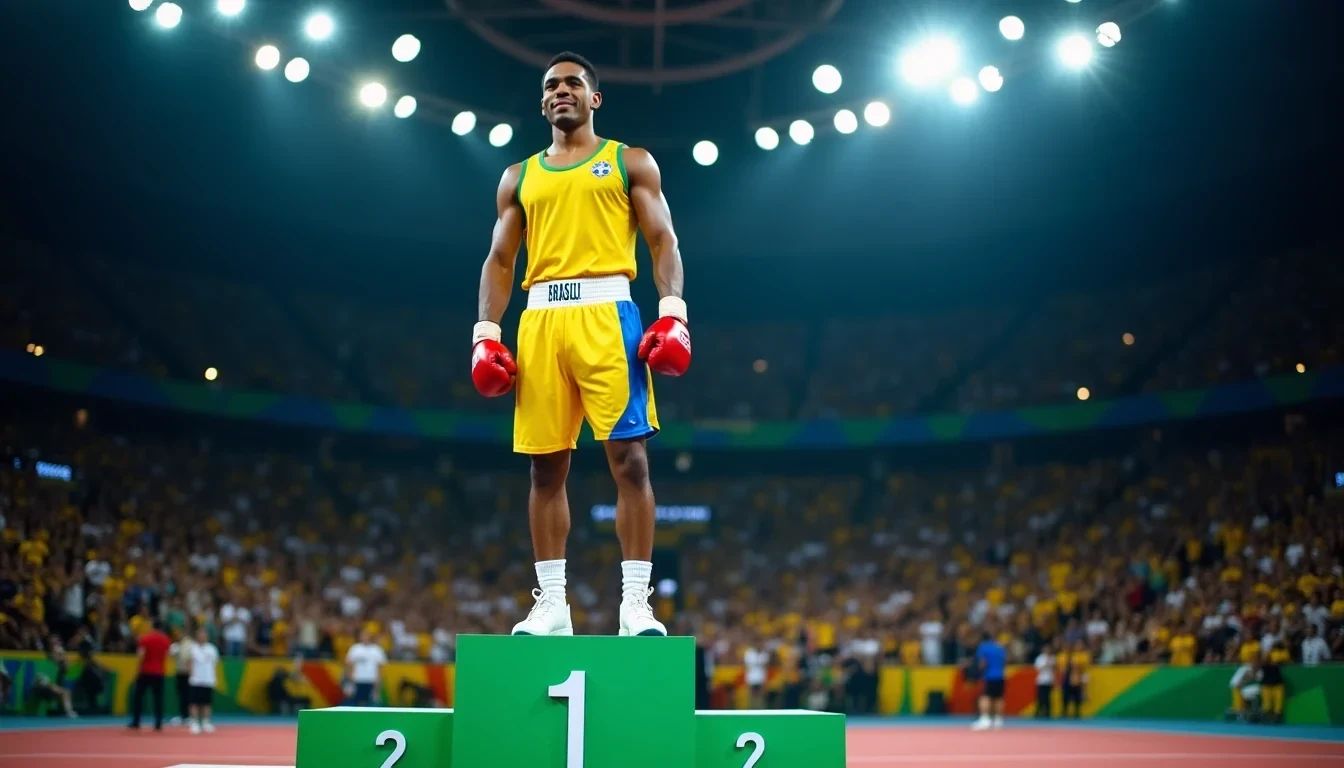
Robson Conceição was born in Salvador on 25 October 1988, thirteen years after Popó. He took a different path to the top, through the amateur system and the Olympics, not the professional grind and pay-per-view circuit. On 16 August 2016, at Riocentro Pavilion 6 in Rio de Janeiro, Conceição beat France’s Sofiane Oumiha by unanimous decision to win lightweight gold at Rio 2016. Brazil had never won Olympic gold in boxing. The home crowd made the moment louder than any arena should legally allow. Conceição turned professional afterward, climbing slowly through sanctioning body rankings until 6 July 2024, when he won the WBC super featherweight title from O’Shaquie Foster in San Diego. The split decision was disputed. The rematch, in November 2024, went to Foster. Conceição held the belt for four months.
Brazil’s Olympic boxing record
The Olympic story stretches back to Mexico City 1968, when Servílio de Oliveira won bronze in the flyweight division. Brazil then waited forty-four years for its next boxing medal. The drought ended at London 2012.
| Games | Boxer | Medal | Weight |
|---|---|---|---|
| Mexico City 1968 | Servílio de Oliveira | Bronze | Flyweight |
| London 2012 | Esquiva Falcão | Silver | Middleweight (75 kg) |
| London 2012 | Yamaguchi Falcão | Bronze | Light heavyweight (81 kg) |
| London 2012 | Adriana Araújo | Bronze | Women’s lightweight (60 kg) |
| Rio 2016 | Robson Conceição | Gold | Lightweight (60 kg) |
| Tokyo 2020 | Hebert Conceição | Gold | Middleweight (75 kg) |
| Tokyo 2020 | Beatriz Ferreira | Silver | Women’s lightweight (60 kg) |
| Tokyo 2020 | Abner Teixeira | Bronze | Heavyweight (91 kg) |
| Paris 2024 | Beatriz Ferreira | Bronze | Women’s lightweight (60 kg) |
Adriana Araújo’s bronze in 2012 made her Brazil’s first female Olympic boxing medalist. The Falcão brothers, Esquiva and Yamaguchi, took silver and bronze in the same Games, a family double that still stands alone in Brazilian Olympic history.
Tokyo and Paris
Hebert Conceição, no relation to Robson, won Brazil’s second Olympic boxing gold at Tokyo 2020, held in 2021. He stopped Ukraine’s Oleksandr Khyzhniak in the middleweight final with a right hand in the third round that ended the fight standing. The knockout was sudden and violent, replaying for years.
Beatriz Ferreira took silver in Tokyo at 60 kg, losing to Ireland’s Kellie Harrington in the final. She came back at Paris 2024 and won bronze on 3 August, beating France’s Wassila Lkhadiri in the quarterfinal before falling to Harrington again in the semifinal. Two Olympics, two medals. Her style, built on pressure and volume, makes her one of the most watched female boxers in the country.
Where to watch and train
As of 2024, professional boxing in Brazil airs primarily on ESPN and SporTV cable channels, with DAZN streaming select international cards. Major fights with Brazilian headliners often land on Globo’s free-to-air sports programming when the draw is large enough.
Training facilities cluster in the same cities that produce the fighters. Salvador, São Paulo, Rio de Janeiro, and Brasília all host competitive amateur programs and professional gyms. The Confederação Brasileira de Boxe runs national tournaments that feed into Olympic selection. Community projects in Salvador’s poorer neighborhoods operate on minimal budgets but keep finding talent. Popó came through one. Robson Conceição came through another. The pipeline is narrow but it has not broken.
For visitors wanting to train, academias de boxe in São Paulo’s Vila Mariana and Rio’s Lapa neighborhoods offer drop-in classes for weekly rates, typically R$ 150-300 per week as of 2024. Serious amateurs can approach state boxing federations for tournament schedules and affiliated clubs. The Brazilian Olympic Committee’s training centers in São Paulo and Rio are closed to the public but host national team camps that local media cover.