Esports
How To Watch Brazil's CBLOL League Of Legends And Get Tickets
Brazil's top professional League of Legends league, CBLOL, was established by Riot Games in 2012.
Riot Games opened the Brazilian League of Legends server in 2012 and immediately followed it with a professional league. That league, the Campeonato Brasileiro de League of Legends, has since become the definitive competitive stage for the game in the country. For anyone who plays League and wants to follow the local scene, the CBLOL is where Brazilian teams fight for domestic titles and the right to represent the region at international tournaments.
What the CBLOL Is and Who Runs It
Riot Games operates the CBLOL directly. The league launched in the same year as the dedicated Brazilian server, formalising a competitive structure that had previously existed only in scattered online tournaments and LAN events. Twelve years later, it remains the top tier of professional League of Legends in Brazil, with a format that has evolved repeatedly while keeping the same basic function: crown a national champion and send that team to face North American, European, Korean and Chinese opponents on the world stage.
The league currently sits at the centre of a two-tier system. Below it sits the Circuito Desafiante, Brazil’s official second division, where developing rosters compete for promotion into the top flight. Teams move between the two divisions based on performance, keeping the bottom of the CBLOL competitive and giving new organisations a path in.
The 2026 Season Format
The 2026 CBLOL season runs across three distinct stages. It opens with the Copa CBLOL, an eight-team single round-robin where every match is a best-of-one. This stage functions as a warm-up tournament, giving teams early competitive reps and fans an immediate reason to tune in after the off-season.
Split 1 and Split 2 follow the Copa, and these carry the real weight. Each split features the same eight teams in another single round-robin, but the format shifts to best-of-three matches with the Fearless Draft system, which prevents teams from reusing champions they have already played in a series. The top six teams from each split advance to playoffs. Stage winners earn international slots: the Split 1 champion goes to the Mid-Season Invitational, the Split 2 champion qualifies for the League of Legends World Championship, and the Copa CBLOL winner receives a berth to the First Stand tournament.
This three-stage structure replaced a shorter-lived experiment. In 2025, Riot merged the CBLOL into the League of Legends Tour of the Americas as its South Conference, folding Brazilian teams into a broader Latin American league. The reversal came on 28 September 2025, when Riot announced the CBLOL would return as a standalone top-tier league for 2026. Brazilian fans and organisations had pushed back against the LTA format, and the reinstatement restored a domestic identity that the South Conference arrangement had diluted.
The Clubs with the Most Titles
INTZ leads the historical table as of 2026, with five CBLOL championships. The organisation built its record across the mid-2010s, when it dominated domestic competition and developed players who later appeared at international events.
Four clubs sit tied behind INTZ at four titles each. paiN Gaming, KaBuM! and LOUD have all reached that mark through different eras of the league. paiN’s 2015 victory at Allianz Parque remains one of the most memorable finals in CBLOL history: a 3-0 demolition of INTZ in August of that year, played in front of roughly 12,000 fans at the Palmeiras stadium in São Paulo. KaBuM! earned its four titles through consistent contention across multiple roster iterations. LOUD, the newest of the four-title clubs, rose to prominence more recently with rosters that blended veteran Brazilian talent and imported players.
RED Canids holds three titles, placing it sixth on the all-time list. The organisation has remained competitive without reaching the sustained dominance of the clubs above it.
Finals Beyond the Studio
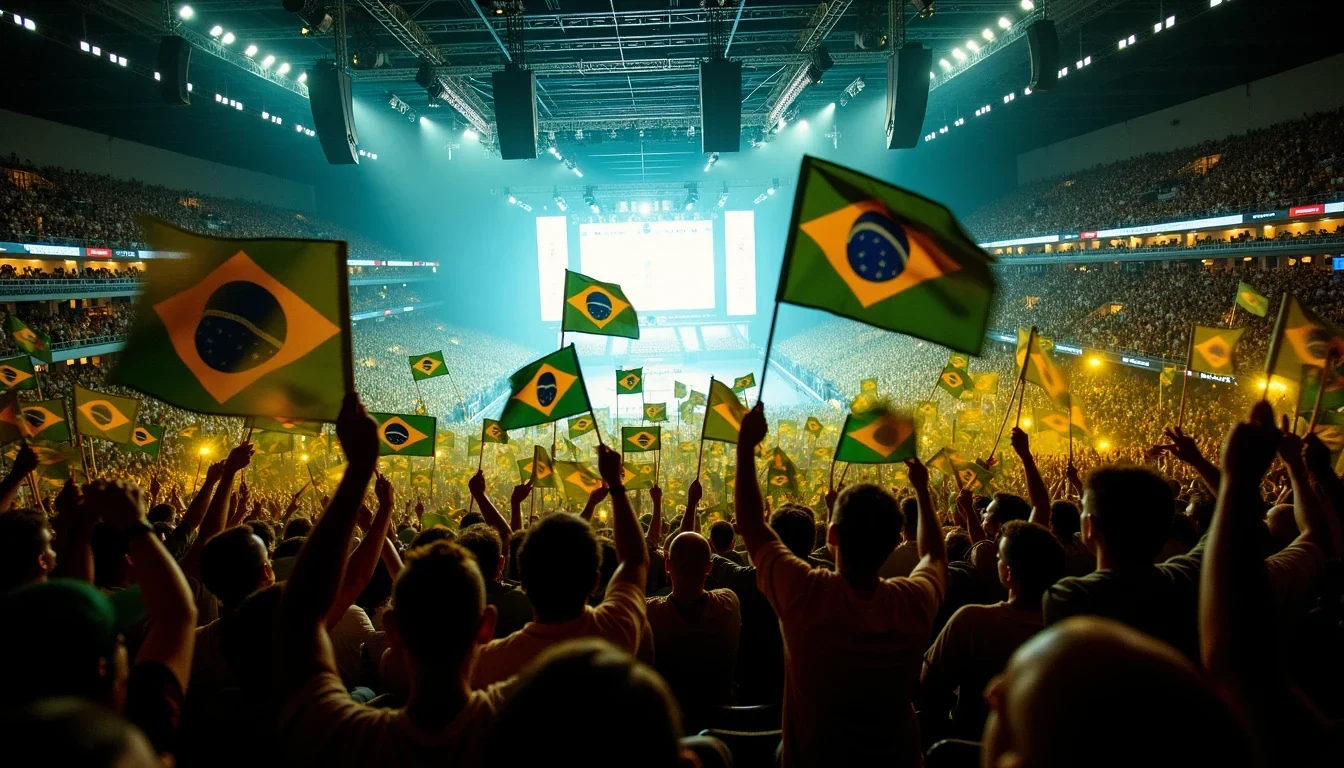
The CBLOL’s regular-season home is intimate, but its championship events have repeatedly outgrown it. The league has a history of moving its biggest matches to major venues across Brazil, often selling them out rapidly.
The 2015 final at Allianz Parque established the template. paiN Gaming’s 3-0 win over INTZ drew about 12,000 spectators to the football stadium, proving that Brazilian esports could fill traditional sporting venues. Seven years later, the 2022 final at Ginásio do Ibirapuera in São Paulo sold out in under two hours, with demand crashing ticket systems before many fans could complete purchases.
In 2024, the final travelled to Mineirinho in Belo Horizonte, the 25,000-capacity indoor arena that has hosted basketball, volleyball and major concerts since 1980. The choice of Minas Gerais marked the first time the CBLOL final left São Paulo since the pre-pandemic era. For 2026, Riot has scheduled a final at Arena Carioca 1 in Rio de Janeiro, continuing the rotation through Brazil’s largest metropolitan areas.
How to Watch and How to Get Tickets
Every CBLOL match streams live on Twitch and YouTube through Riot’s official channels. Broadcasts run in Portuguese, with English co-streams and VODs available for international viewers. For fans outside Brazil, this is the simplest access point: the streams are free, start punctually, and include full pre-game and post-game coverage.
Attending in person requires more planning. Regular-season matches, including Copa CBLOL fixtures, take place at the Riot Games Arena on Av. Thomas Edison 849 in Barra Funda, São Paulo. The venue holds approximately 147 spectators in a purpose-built studio environment, with teams playing on a central stage and fans seated close enough to hear caster calls bleed through from the production booth.
Tickets for Copa CBLOL 2026 went on sale through Eventim at R$120 for full-price admission and R$60 for half-price eligibility. Purchases are capped at four tickets per CPF per day, a restriction designed to limit scalping for high-demand matchups. The same ticketing infrastructure typically handles playoff and final sales, though prices and availability shift based on venue capacity. For finals at Allianz Parque, Mineirinho or Arena Carioca 1, Riot usually announces sale dates several weeks in advance through the official CBLOL social channels, and the best seats disappear within minutes.
Getting to the Riot Games Arena is straightforward. Barra Funda sits at the western edge of São Paulo’s expanded centre, served by the Barra Funda metro and train terminal. From the station, the walk to Av. Thomas Edison takes about ten minutes. The neighbourhood is primarily commercial and light industrial, with limited dining options nearby, so most attendees eat before arriving or grab food at the small concessions inside the venue.
For visitors planning around a CBLOL trip, the practical sequence runs: check the season schedule on lolesports.com, confirm which matches are at the Riot Games Arena versus a larger final venue, set a ticket-sale reminder if demand looks high, and book accommodation near Barra Funda or along the metro’s Red Line for easy arena access. São Paulo’s feriado weekends often coincide with major esports events, so hotel prices spike accordingly.