Festivals
Belém's Círio De Nazaré Turns October into Its Christmas
Belém's Círio De Nazaré is a colossal October procession in Brazil, uniting millions for a 3.6-kilometer walk and multiple events, celebrated as the city's.
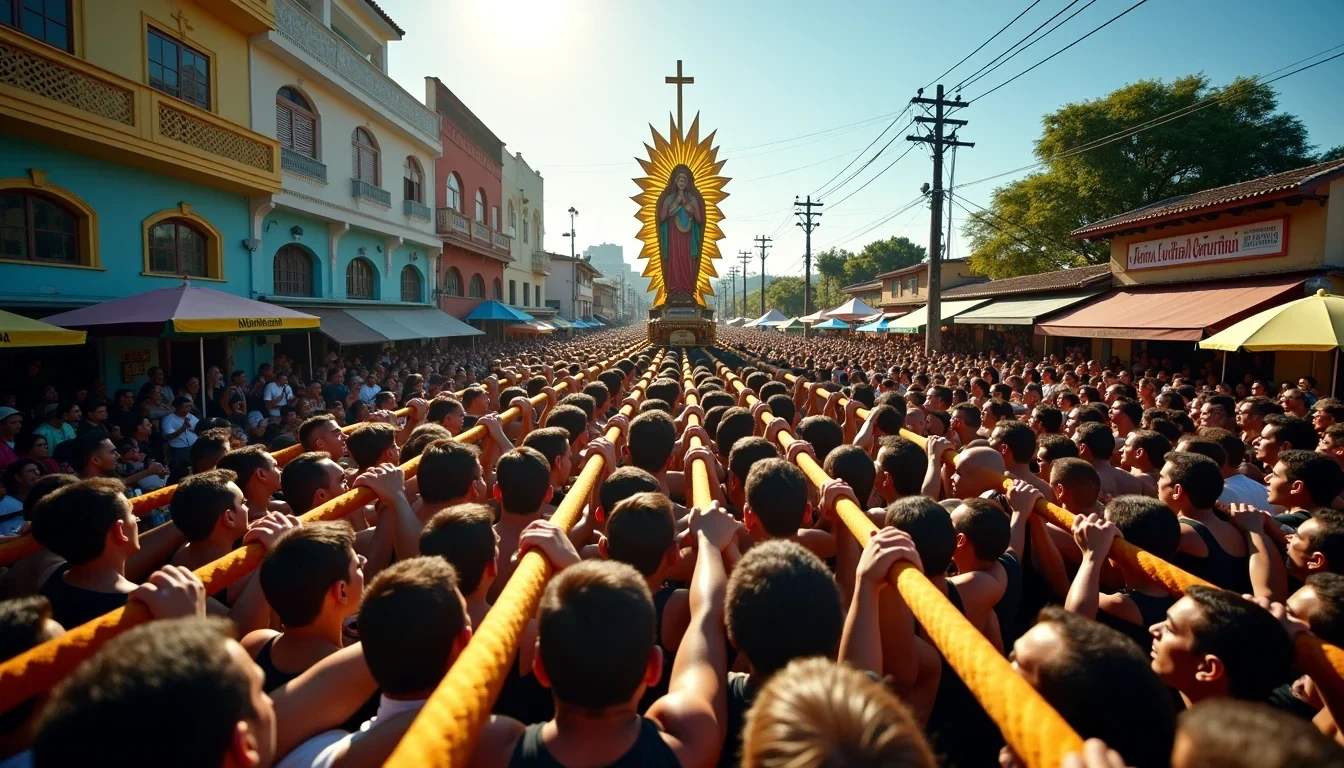
Avenida Nazaré belongs to the crowd by mid-morning. The carved image sways on the berlinda, no larger than a household saint. The carriage crawls forward through a wall of bodies, and the sound is not singing alone but a low, continuous roar of millions trying to pull a saint home. In Belém, Pará, this Sunday in October functions as the city’s de facto Christmas, complete with family lunch, exchanged gifts of wax limbs, and anticipation that empties supermarkets for days. Television cannot convey the scale. The camera flattens the heat, the smell of candles melted onto asphalt, and the crush of shoulders that makes the 3.6-kilometer walk feel like an ocean current.
The 2026 Grande Círio, on 11 October, brought roughly 2.3 million people onto the 3.6-kilometer stretch between the Catedral da Sé and the Basílica Santuário de Nazaré, per the festival organizers. That single procession is the loudest note in a program of fourteen romarias that year. A river parade carried devotion along the water, a motorbike pilgrimage roared through inland routes, and the full schedule recorded something like 7.1 million visits over 149 kilometers of routes. The Trasladação, the night before, pulled another 1.9 million into the streets under floodlights. These are not parade watchers standing politely behind barriers; they are participants in a physical, collective act that turns the entire city into a church without walls.
How a farmer’s find became a city
In 1700, Plácido reportedly came across a dark wooden carving of Nossa Senhora de Nazaré near the Igarapé Murutucu, outside what was then the edge of town. The story goes that the statue kept returning to the streamside each time he carried it away, so locals raised a hermitage on the spot. That modest structure eventually grew into the Basílica Santuário de Nazaré, the white cathedral that now marks the end of every procession, though the original stream has long since disappeared beneath the pavement. Devotion grew privately until 1793, when colonial authorities sanctioned the first public procession. Two centuries later, UNESCO inscribed the festival on its Intangible Cultural Heritage list in 2013, citing its ability to bind identity and belief across generations. The statue itself remains small, dark, and easy to miss on the berlinda; the faithful are not worshipping grandeur, but presence.
The rope and the pilgrims
Faith here is not passive. Millions of promesseiros grip the corda, a thick rope running from the faithful to the berlinda, dragging the carriage through the streets as an act of gratitude or penance. Some crawl. Others walk barefoot across hot asphalt, their soles hardened by months of intention. Many haul wax sculptures of arms, legs, or organs, offerings that represent body parts healed through prayer. The weight is real, and the pace is slow. During the 2026 Trasladação on the night of 10 October, which drew around 1.9 million people, organizers cut the corda earlier than expected, triggering debate about its strength and origin. Some blamed the synthetic fibers imported from outside the region. Sources close to the Diretoria and the Arquidiocese de Belém say a replacement rope manufactured in Pará is under discussion for the 2027 edition, a shift that would keep the material as local as the sweat pulling it.
What the city eats for its October Christmas
By early afternoon on the main Sunday, the spiritual gives way to the gastronomic. The Almoço do Círio is the city’s de facto Christmas lunch, a gathering built around dishes that demand days of preparation. Maniçoba, a stew of ground manioc leaves boiled for up to a week to remove toxins, arrives alongside pato no tucupi, duck simmered in a yellow wild manioc broth sharpened with jambu, the herb that numbs the tongue. You will also find tacacá, a hot soup thickened with tapioca and shrimp, and açaí served savory with fried fish, the Pará way. While families eat, the Arraial de Nazaré keeps running near the Basílica Santuário. The funfair stays open for roughly fifteen days, mixing food stalls with carnival rides, bingo tents, and rope games that look effortless until you try them. It extends the festival well beyond the religious calendar, giving teenagers a reason to stay out and grandparents a reason to sit on plastic chairs and judge the cooking.
How to watch without joining the crush
You do not need to be Catholic or even religious to want a good view. Non-pilgrims should arrive before dawn on the second Sunday in October if they hope to stand anywhere near Avenida Nazaré. The promesseiros begin assembling around the Catedral da Sé as early as 03:00. Renting a balcony along the route is the safest way to see the berlinda above the crush, though landlords charge steep premiums for windows facing the pavement. The Praça Santuário offers a more visceral endpoint, packed with people but positioned right at the Basílica’s doors. Bring water, wear light clothing, and choose closed shoes you do not mind losing. The humidity in Belém can hit ninety percent by 08:00, so electrolyte packets are not an affectation. Avoid carrying anything in pockets that you cannot afford to have crushed. If the Grande Círio feels too intense, the Romaria Fluvial sends boats along the Rio Guamá decorated with lights and ribbons, and the motorbike romaria fills the streets with two-wheeled devotion. Both deliver spectacle without requiring you to touch the corda.
Where to sleep and how to get in
Belém receives the overflow across every neighborhood, but the smartest money lands in Nazaré, Campina, or Cidade Velha, all within walking distance of the procession footpath. Budget travelers can find pousadas near the Ver-o-Peso market, though the early morning walk to the Catedral da Sé takes longer. Mid-range hotels cluster along Avenida Presidente Vargas and fill first. The airport, Val-de-Cães International, sits about ten kilometers from the center. Taxis and ride apps operate normally, though road closures on parade days can turn a fifteen-minute trip into an hour. A taxi or ride app costs more during the event window, and drivers sometimes refuse to enter the closure zone, dropping passengers at the edge of the cordon. The best strategy is to book accommodation inside the perimeter and walk everywhere for the weekend.
When to go and how far ahead to book
The calendar is fixed. The main procession always falls on the second Sunday in October. For 2026, that meant 11 October for the Grande Círio and the night before for the Trasladação. The Diretoria and the Arquidiocese de Belém have already locked in 10 October 2027 for next year’s main event. Hotels in the Nazaré and Cidade Velha neighborhoods sell out months ahead, so booking by June is not excessive. Plane tickets from São Paulo or Brasília to Val-de-Cães International Airport also spike in price the closer you get to the date. Treat the trip like you would December in the South: plan early, pack patience, and expect the city to shut down for something far older than any television broadcast.