Football
Why Brazil Stopped Wearing White After Maracanazo
Brazil's national football team abandoned its white uniform after the devastating 1950 World Cup loss to Uruguay, a tournament with an unusual final-round.
The 1950 World Cup was built backwards. Brazil spent the tournament tearing through opponents, but FIFA clung to a final-round format that refused to guarantee a proper ending. Four teams, one table, the last match decided nothing by design. The hosts needed only a draw against Uruguay on 16 July 1950 at the Maracanã in Rio de Janeiro. They lost 2-1. The white shirts never appeared again.
The Format That Refused to Crown a Champion
FIFA abandoned the knockout bracket for its fourth World Cup. The tournament arrived in Brazil with a closing act that was technically a group stage dressed up as a finale. Brazil, Uruguay, Spain, and Sweden played a single round-robin to determine the winner. There was no semi-final, no scheduled final, just four teams and arithmetic.
Brazil’s last fixture against Uruguay carried championship weight only because earlier results happened to pile up that way. A draw was enough; a point and the trophy stayed in Rio de Janeiro. The format turned a formality into catastrophe.
The Run That Made a Draw Feel Certain
Brazil had spent the final round making elite opponents look like training cones. They opened with a 7-1 dismantling of Sweden at the Maracanã on 9 July 1950. Three days later they beat Spain 6-1 at the Pacaembu in São Paulo. Ademir finished as the tournament’s top scorer with nine goals. The attack looked unstoppable, and the defence looked untested. Four points, two matches, one to play.
The mood in Rio was not cautious optimism. It was coronation preparation. Newspapers printed early editions declaring Brazil world champions. The squad received gold watches before the match. The city bought fireworks.
The 79 Minutes That Rewrote Everything
16 July 1950. The official attendance was 173,850, though accounts from the day push the figure toward 200,000. The Maracanã swallowed both numbers without appearing full.
Friaça scored for Brazil two minutes after half-time, in the 47th minute. The stadium detonated. For nineteen minutes the country held its breath in celebration rather than tension.
Juan Alberto Schiaffino equalised for Uruguay in the 66th minute. The noise changed pitch. Alcides Ghiggia scored the winner in the 79th minute, driving a low shot past goalkeeper Moacir Barbosa at the near post. Uruguay won 2-1 and claimed their second world title. Brazil’s players stood on the pitch as strangers began dismantling the victory decorations.
The Goalkeeper Who Carried the Defeat Alone
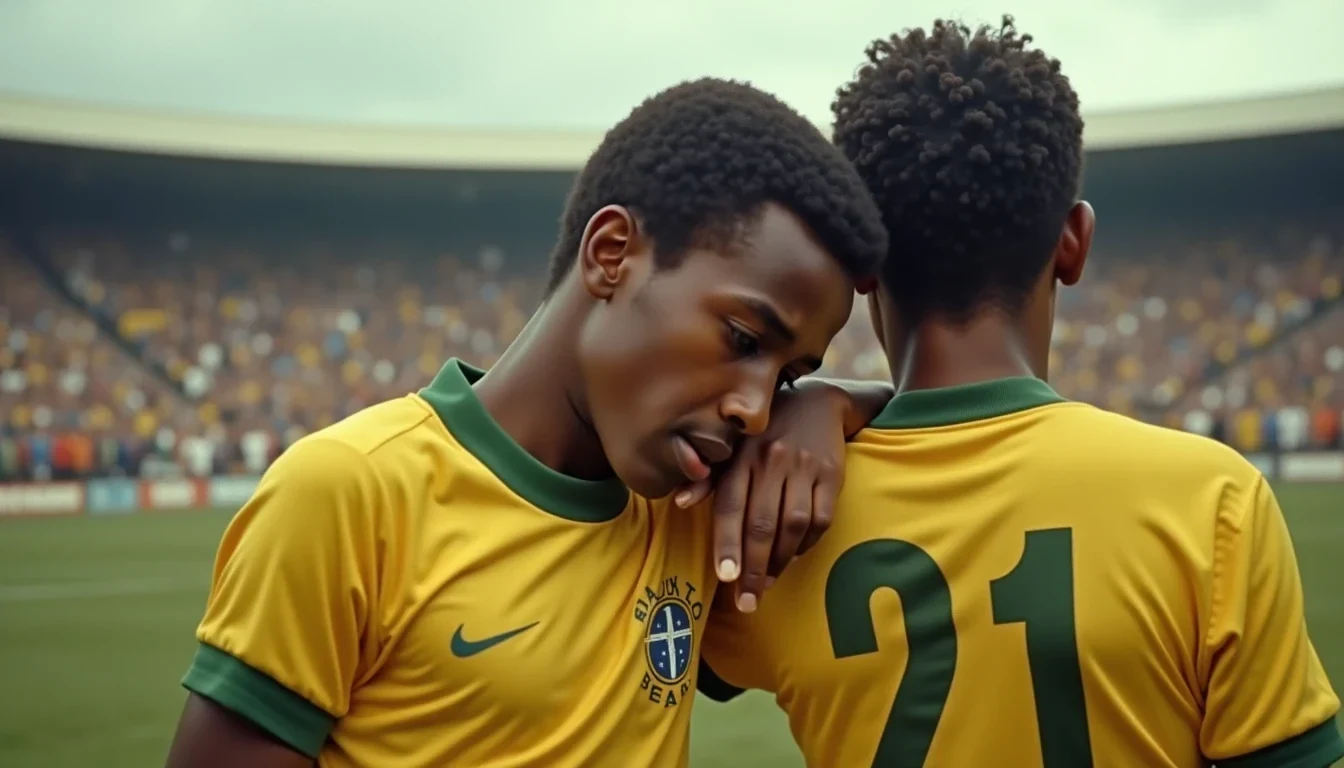
Barbosa took the blame for Ghiggia’s goal and never escaped it. The near-post finish became the only frame of reference for his entire life. He was barred from national team camps and refused coaching jobs. Decades later he was still being introduced as the man who lost the 1950 World Cup.
The Museu do Futebol in São Paulo later ran an online exhibition marking 100 years since his birth, attempting to place him back in the full context of Brazilian football history rather than the single moment that consumed him. Barbosa died in 2000. He had spent half a century as the country’s most famous scapegoat.
The Contest That Dressed Brazil in Yellow
The white kit with blue collars was retired immediately. In its place came a national design competition launched by the newspaper Correio da Manhã alongside the CBD, the Brazilian Sports Confederation that preceded today’s CBF. The contest appeared in the newspaper’s 23 September 1953 edition with one binding rule: use all four colours of the Brazilian flag.
Aldyr Garcia Schlee, a 19-year-old from Jaguarão in Rio Grande do Sul, submitted the winning design. Yellow shirt with green trim. Blue shorts. White socks. The canarinho debuted in 1954 and has defined Brazilian football identity ever since. Schlee died in 2018, having watched his creation become one of the most recognisable uniforms in global sport.
The Stadium That Keeps Hosting
The Maracanã has outlived the trauma of its founding moment. It opened for the 1950 tournament, was rebuilt for the 2014 men’s World Cup where it hosted both the opening match and the final, and now holds its next appointment. The stadium will stage the opening match of the 2027 Women’s World Cup on 24 June 2027 and the final on 25 July 2027.
The same stands that absorbed the silence of 1950 will fill again. The yellow shirts that replaced the white ones will pack the seats. The format will be a straight knockout.