Basketball
Find a Street Basketball Game in São Paulo and Rio
Unlock a unique side of São Paulo and Rio by joining a racha, Brazil's informal pickup basketball game. Learn how to find a court and play by simple rules.
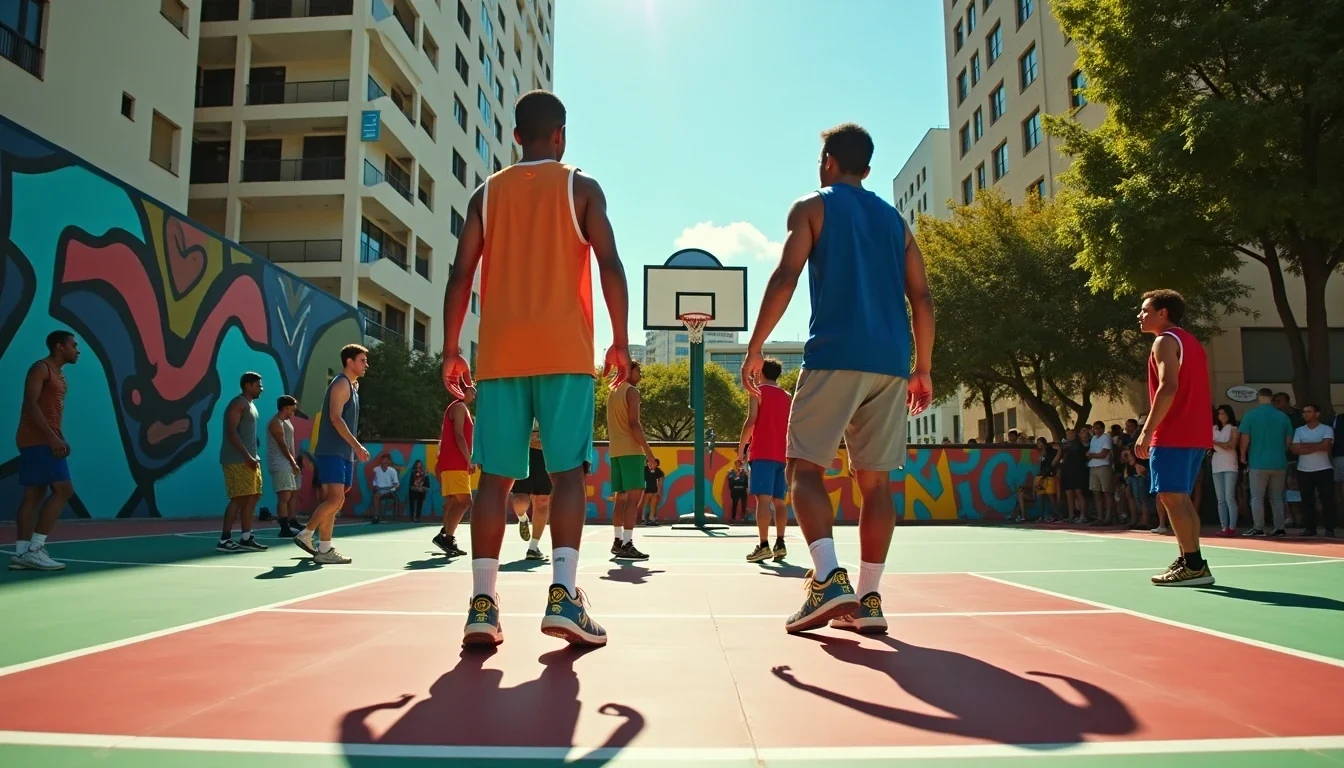
Pack sneakers on your Brazil trip to unlock a side of the cities that tour buses never reach. The court becomes your entry point: a concrete rectangle where cariocas and paulistanos argue fouls, split teams by pointing, and play until the lights cut out or someone scores 21. This is the racha, Brazil’s pickup basketball ecosystem. Joining one requires no membership card, no WhatsApp group, and no advance planning. You show up, ask who has next, and wait your turn.
How a Racha Actually Works
The grammar is simple. Walk onto any occupied court and call out “Quem tem a próxima?” Someone will raise a hand or nod, and you have claimed the following game. Teams form on the spot, usually 3-on-3 or 5-on-5, divided by captains picking sides or players self-sorting by height and shoe quality. Games run to a set score, most commonly 11 or 21, with inside shots worth one point and outside shots worth two. Make the winning basket and your team stays on for the next challenger. Lose, and you rotate to the back of the informal queue.
There are no referees. Players call their own fouls and out-of-bounds, so the social contract matters more than the rulebook. Disputes get settled by possession going to the team everyone likes less, or by shooting for it. The rhythm is relentless: games end fast, new teams cycle in every ten minutes, and the standard of play spikes on weekends when serious players arrive.
Where to Play in São Paulo
Parque Ibirapuera, Vila Mariana, operates five courts in the Centro Esportivo zone near Gate 9. Entry to the park and the courts is free, no booking required, and gates open 05:00 to 23:00 daily. The surface is standard outdoor acrylic, the rims hold up, and the weekend crowd runs deep enough that you might wait three games before touching the ball. Arrive before 09:00 on Saturday if you want to run immediately.
Parque Villa-Lobos, Alto de Pinheiros, offers a different draw. The NBA renovated one court here in June 2023 through its NBA Station programme, commissioning São Paulo graffiti artist Neto Sete Oito to paint the surface and backboards. The result is playable art: geometric patterns in saturated color that photograph well and grip adequately when dry. The court sits in the park’s western quadrant, accessible by the 774N bus from Pinheiros metro or a twenty-minute walk from the Villa-Lobos-Jaguaré station on Line 9-Emerald.
Sesc SP units spread courts across the city, though access varies by location. Sesc 24 de Maio, downtown, and Sesc Pompeia, in the west zone, both maintain indoor and outdoor courts. Some units charge nothing; others require the Sesc membership, which runs around R$ 60 annually as of 2024. Check the specific unit’s site before you travel, since policies shift and weekend hours often differ from weekday slots.
Where to Play in Rio de Janeiro
The Aterro do Flamengo court sits on Avenida Infante Dom Henrique inside Parque do Flamengo, with the bay visible over the retaining wall. Budweiser funded a full refurbishment in 2019: new surface, new glass backboards, and perimeter seating that fills with spectators by mid-morning. The location is deliberately central, walkable from Flamengo metro (Line 1), Glória metro (Line 1), and Largo do Machado metro (Lines 1 and 2). Sunday mornings bring the densest competition, but the court runs games most daylight hours.
For the city’s most consequential street basketball location, take the metro to Madureira and walk to the Viaduto Negrão de Lima. Under the concrete arches, CUFA, the Central Única das Favelas, maintains a court that functions as a weekly meeting point for players from Rio’s northern and western peripheries. The setting is industrial and loud, with trains passing overhead, but the basketball is organized and the standard is high. Here, the racha system connects to something larger.
From Street Games to LIBBRA and Beyond
CUFA created the Liga Brasileira de Basquete de Rua in 2002, and national editions began in 2005. LIBBRA runs tournaments that preserve street rules, winners-stay format, and local refereeing, but adds structure: registered teams, seasonal standings, and regional qualifiers that feed a national final. The league operates in favelas and peripheral neighborhoods across multiple states, and several LIBBRA alumni have advanced to professional clubs or the Brazilian national 3x3 programme.
The cultural footprint is as important as the talent pipeline. LIBBRA validates a form of basketball that developed without federation support, gym rentals, or youth academies. The league’s tournaments draw crowds that mix neighborhood residents, scouts, and local politicians, and the Madureira court remains its symbolic headquarters.
The FIBA 3x3 Pathway
Players who want to test themselves beyond the racha system can enter organized 3x3 through the Confederação Brasileira de Basquete’s domestic circuit. FIBA 3x3 uses a half court, one basket, and games to 21 points or ten minutes, whichever arrives first. Shots inside the arc count one point; shots from outside count two. The shot clock runs twelve seconds. There are no coaches during play and no halftime; substitutions happen on dead balls with a check at the top of the key.
Brazil will host two FIBA 3x3 Challenger events in 2026. The first runs 27 to 28 May at Pátio Brasil Shopping in Brasília, Distrito Federal. The second follows 31 October to 1 November in Diadema, São Paulo metropolitan region. Brazilian teams qualify through the Road to Challenger circuit, operated by the CBB in partnership with MCS Sports, which runs qualifying events in multiple cities during the months before each Challenger. The top domestic finishers receive invitations to the international field.
These Challengers carry FIBA ranking points, which feed Olympic qualification and World Tour entry. For a player coming from weekend rachas at Ibirapuera or Madureira, the competitive distance is real, but the structural path now exists.
Practical Notes for Playing
Hydration is not optional. Rio and São Paulo both see summer temperatures above 30°C from December through March, and humidity pushes the effective heat higher. Bring at least one litre of water for a morning session; courts have fountains intermittently, but you cannot rely on them. Electrolyte packets weigh nothing and prevent the cramping that ends games early.
Go early. The best competition and the coolest temperatures both arrive before 09:00. By 11:00 on weekends, courts at Ibirapuera and the Aterro are full, queues stretch to four or five teams, and the pace slows as heat accumulates.
Footwear: outdoor courts in Brazil vary. The NBA Station court at Villa-Lobos and the Aterro surface are smooth and forgiving. Older municipal courts may have uneven concrete, loose pebbles, or low spots that hold water after rain. A shoe with sufficient tread and ankle support protects against both the surface and the occasional defender who slides under your jump shot.
Crowd management: rachas are social events. Spectators sit on the baseline, comment loudly on every play, and occasionally step onto the court to retrieve errant passes. Play through it. The environment rewards players who communicate on defense and call their own picks; it punishes isolation basketball and players who complain about contact.
Rain cancels everything. Neither São Paulo nor Rio maintains covered public courts in sufficient quantity, and outdoor surfaces become slick and unplayable quickly. Check the forecast, but know that Brazilians often play through light drizzle until someone slips badly enough to stop the game.
What to Bring and What to Skip
Bring: your own ball if you have one, though most courts have a community ball in rotation; water; sunscreen; a small towel; cash for the coconut water vendors who circle Ibirapuera and the Aterro on weekends.
Skip: elaborate pre-game routines that hold up the queue, arguments about foul calls that nobody will resolve, and the assumption that speaking English excludes you. Enough players in both cities have travelled or studied abroad that language barriers dissolve quickly, and basketball vocabulary translates through gesture regardless.
The racha system rewards patience and punishes entitlement. Wait your turn, play hard, lose with a handshake, and you will find yourself running again within the hour. Win, and you stay on until someone better arrives, which on a Saturday morning at Madureira or Villa-Lobos, happens faster than you might expect.