Basketball
Every Brazilian Who Played In The NBA, Their Rings, And New Coach
Since 1989, nineteen Brazil-born players have played in the NBA, with two earning championship rings and one becoming a Chicago Bulls coach.
Nineteen Brazil-born players have logged minutes in the NBA since Rolando Ferreira checked into a Portland Trail Blazers game in 1989. That number comes from Basketball-Reference, which tracks every birth certificate in the league’s database. Two of those nineteen own championship rings. One now draws up plays from the Chicago Bulls sideline. The rest built careers of varying length and impact, but each name answers a specific question Brazilian fans type into search bars: quantos brasileiros jogaram na NBA?
The First Two
Rolando Ferreira broke the seal in 1989, becoming the first Brazilian to appear in an NBA box score. He played 29 games for Portland, scored 46 total points, and never returned to the league. João Vianna, nicknamed Pipoka, followed three years later with a three-game stint for the Dallas Mavericks in 1992. Neither player established a lasting foothold, but their presence proved the NBA was accessible to Brazilians developed entirely outside the American system.
Oscar Schmidt warrants a single line here. The New Jersey Nets selected him in the 1984 draft, but he never signed or played in the league. He chose instead to dominate European competitions and Olympic tournaments. Ferreira and Vianna remain the true on-court pioneers.
The 2000s Wave
Brazilian NBA representation exploded in the early 2000s, producing three players who defined the country’s basketball identity abroad for more than a decade.
Nenê Hilário arrived as the 7th overall pick in 2002, selected by the New York Knicks and immediately traded to the Denver Nuggets. He played 17 seasons across Denver, Washington, and Houston, accumulating 965 games and 10,909 points. No Brazilian has matched his longevity or scoring output. The 2002 draft class produced Yao Ming, Amar’e Stoudemire, and Caron Butler; Nenê outlasted nearly all of them.
Leandro Barbosa, drafted 28th by the San Antonio Spurs in 2003, became “Leandrinho” to Brazilian fans and “The Blur” to everyone else. He won the NBA Sixth Man of the Year award in the 2006/07 season with the Phoenix Suns, averaging 18.1 points in 32.7 minutes per game off the bench. His speed in transition made him a highlight staple during the Steve Nash era.
Anderson Varejão, the 30th pick in 2004, spent twelve seasons as Cleveland’s kinetic energy source, hair flopping, charges taken, rebounds contested. In 2016 he experienced one of the strangest Finals trajectories in league history: traded from Cleveland to Golden State mid-season, he played for both teams in the same championship series. The Cavaliers won in seven games. Varejão’s ring count stayed at zero.
The Rings
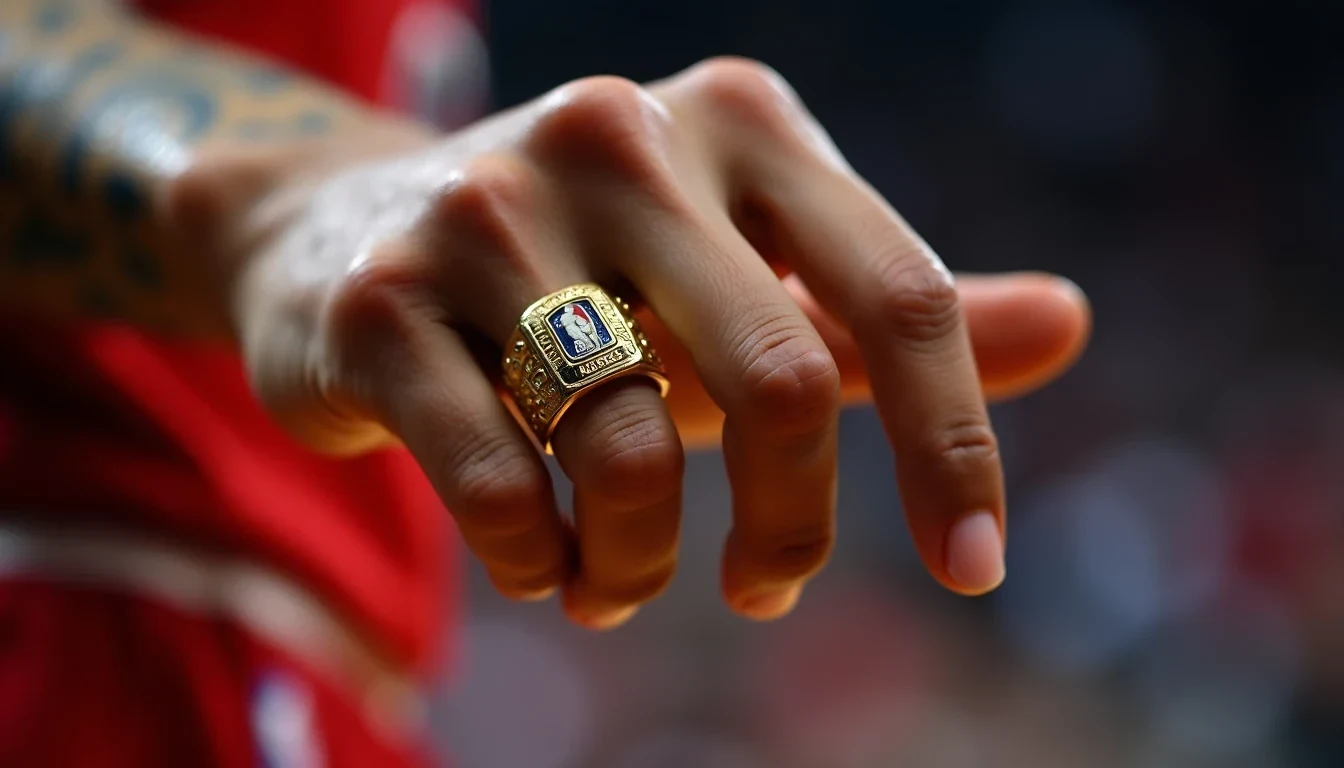
Only two Brazilians have earned NBA championship jewelry.
Tiago Splitter won his with the San Antonio Spurs in 2014, starting all five Finals games against Miami and averaging 22.4 minutes in the series. Gregg Popovich trusted him to defend Chris Bosh and space the floor just enough to keep the offense functional. Splitter’s ring came in his fourth NBA season, after the Spurs had lost the 2013 Finals to the same Heat team.
Leandro Barbosa collected his the following year, joining the 2014/15 Golden State Warriors as a veteran bench piece. He played 66 regular-season games and 16 playoff contests, including spot minutes in the Finals against Cleveland. At 32, Barbosa became the second Brazilian champion, capping a career arc that had already included the Sixth Man trophy and a 2012 return to Brazil with Flamengo.
The Full Roster
Beyond the headline names, thirteen other Brazilians have appeared in NBA games. The list includes:
| Player | Draft/Entry | NBA Tenure | Notable Teams |
|---|---|---|---|
| Rafael Araújo | 8th pick, 2004 | 2004-2007 | Toronto, Utah |
| Alex Garcia | Undrafted | 2003-2004 | San Antonio, New Orleans |
| Marcus Vinicius | 43rd pick, 2006 | 2007-2008 | New Orleans |
| Vítor Faverani | Undrafted | 2013-2014 | Boston |
| Fab Melo | 22nd pick, 2012 | 2012-2013 | Boston |
| Lucas Nogueira | 16th pick, 2013 | 2014-2018 | Toronto |
| Bruno Caboclo | 20th pick, 2014 | 2014-2021 | Toronto, Memphis, Sacramento, Houston |
| Cristiano Felício | Undrafted | 2015-2021 | Chicago |
| Marcelo Huertas | Undrafted | 2015-2017 | Los Angeles Lakers |
| Raul Neto | 47th pick, 2013 | 2015-2023 | Philadelphia, Utah, Washington, Cleveland |
| Didi Louzada | 35th pick, 2019 | 2021-2022 | New Orleans, Portland |
| Mãozinha Pereira | Undrafted | 2023-2024 | Memphis |
Several of these careers ended abruptly. Fab Melo played only six NBA games before returning to Brazil, where he died in 2017 at age 26. Lucas Nogueira’s career stalled after 141 games due to knee complications. Bruno Caboclo, drafted as a raw teenager with a 7’7” wingspan, never developed consistent rotation minutes despite multiple opportunities.
The Current Flag
Gui Santos carries Brazil’s solo NBA representation as of the 2026/27 season. Born in Brasília and developed at Minas Tênis Clube in Belo Horizonte, Santos was the 55th pick in the 2022 draft, selected by the Golden State Warriors. He spent his first professional seasons splitting time between Santa Cruz in the G-League and spot minutes with the main roster, gradually earning Steve Kerr’s trust through defensive versatility and transition finishing.
In September 2026, Santos signed a contract renewal with Golden State, securing his place through the 2026/27 season. A Folha de Pernambuco profile from earlier that year quoted him stating his intention to establish himself as a permanent rotation piece. At 23, he remains the youngest Brazilian in league history to receive a second guaranteed contract.
From the Bench to the Headset
Tiago Splitter’s post-playing career has moved faster than his development as a player ever did. After retiring in 2017 due to chronic hip issues, he joined the Brooklyn Nets as a player development coach, then moved to the Houston Rockets staff. In 2024 he became interim head coach of the Portland Trail Blazers, taking over mid-season and stabilizing a fractured locker room.
The Chicago Bulls hired him as their full-time head coach in June 2026, making Splitter the first Brazilian to lead an NBA franchise. He inherits a roster built around Coby White and DeMar DeRozan, with the immediate task of ending Chicago’s playoff drought. At 41, Splitter has seven years of coaching experience and one championship as a player. No Brazilian has held comparable authority in the league.
How They Get There
The pathways have diversified since Ferreira’s era. The domestic Novo Basquete Brasil (NBB), founded in 2008, now functions as a legitimate proving ground. Santos developed entirely within its Minas Tênis Clube system before declaring for the draft. European leagues, particularly Spain’s Liga ACB and Italy’s Lega Basket Serie A, remain common intermediate steps for players seeking professional seasoning against older competition.
The American college route produces fewer Brazilian NBA players than it does for other international markets. Only a handful, including Lucas Nogueira’s brief Florida prep stint, have gone through the NCAA system. The G-League has become more prominent as a direct development path, with Santos himself spending significant time in Santa Cruz before cracking Golden State’s rotation.
The draft remains the primary entry point for Brazilians with NBA aspirations. Of the nineteen players on Basketball-Reference’s list, fourteen were selected in NBA drafts. The five undrafted players, including Alex Garcia and Cristiano Felício, reached the league through summer league performances, training camp contracts, and G-League production.
The 2026/27 season offers one active player and one head coach. For a country of 215 million with deep basketball infrastructure in São Paulo, Rio de Janeiro, and the federal district, that number feels low. But it also represents continuity: from Ferreira’s 29 games in 1989 to Santos’s renewed Warriors contract thirty-seven years later, the pipeline has never fully closed.