Football
Brazil's Futsal Roots and How Small Courts Shaped Global Football
Futsal, born in 1930s Uruguay, rapidly spread to Brazil, where its unique small-court rules and compressed geometry honed the exceptional skills of future.
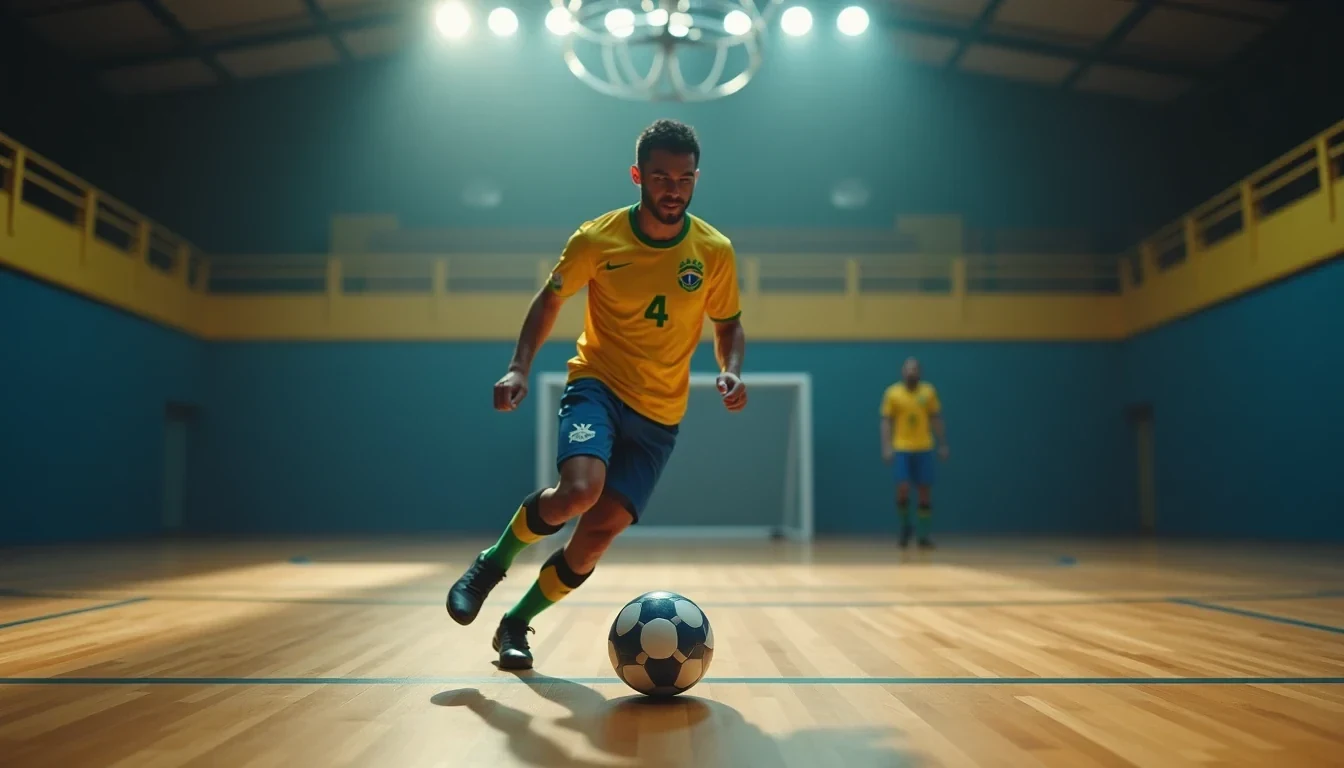
Every Brazilian player who has lifted the FIFA Futsal World Cup trophy has done so on a court smaller than a basketball arena, using a size-four ball that is heavier and deader than the one used on grass. The reduced bounce keeps the ball on the floor, forcing players to use the sole and the instep rather than hopeful punts. The game runs five against five, with rolling substitutions and a stopped clock that pauses whenever the ball leaves play, killing momentum the way a basketball referee does at the end of a close quarter. A match lasts forty minutes, not ninety, and the goals stand three meters wide by two meters high, dimensions lifted straight from handball. This compressed geometry leaves no room for passengers. Every player must move constantly, receive under pressure and pass into lanes that close in less than a second.
The Uruguayan Invention That Crossed the Border
In 1930 Juan Carlos Ceriani sketched out the first rules in Montevideo, Uruguay, hoping to give YMCA youth programmes a way to play football indoors when winter rains closed the parks. He took the five-a-side lineup and the forty-minute duration from basketball, the court proportions and goal dimensions from handball, and the restrictions on goalkeeper movement from water polo. The rules were first printed in 1933, and the hybrid spread quickly across the River Plate into Brazil. In Brazil the sport took the name futebol de salão, a phrase that still conjures images of humid gymnasiums in São Paulo and Rio de Janeiro where the air smells of rubber and sweat. The sport kept that Portuguese name for decades until a bureaucratic clash forced a change. FIFA objected to the use of the word fútbol in any title it did not control, so in 1985 the governing bodies registered the name futsal internationally, a compressed portmanteau that survived the dispute.
Six Titles and a Drought Broken
Brazil owns the FIFA Futsal World Cup in a way no other nation owns any FIFA tournament. The senior men’s team has won the competition six times: 1989 in the Netherlands, 1992 in Hong Kong, 1996 in Spain, 2008 in Brazil itself, 2012 in Thailand, and 2024 in Uzbekistan. No other country has more than two titles. The most recent final took place on 6 October 2024 at the Humo Arena in Tashkent. Brazil beat Argentina 2-1. Ferrão opened the scoring, Matías Rosa equalised for the Albiceleste, and Rafael struck the winner. This victory ended a twelve-year wait. Brazil had missed the final entirely in 2016 and again in 2021, the longest gap between trophies in the country’s futsal history. The 2024 squad returned to the top without losing a knockout match, confirming that the production line of talent inside Brazilian gymnasiums remains intact even when the world catches up.
The Names That Learned in Tight Corners
Zico, speaking with the authority of someone who mastered both codes, has singled out Ronaldinho, Neymar, Ronaldo Nazário and Rivellino as players whose foundations were laid on small courts. He noted that the constant pressure of a walled court teaches a young athlete to shield the ball with every surface of the foot. Neymar has said publicly that futsal taught him to think quickly, a requirement when three opponents press you inside a space no larger than a living room. The connection is easy to see in the way Ronaldinho trapped the ball with the sole of his boot, a futsal hallmark, or in the sharp pivots Ronaldo used to beat defenders in corridors too narrow for long sprints. Rivellino’s powerful striking and close dribbling also carry the fingerprints of gymnasium training. Futsal is not a factory that guarantees genius. Brazil produces great players through pelada on asphalt, through beach football on Copacabana sand, and through the formal academies that now dot the country. The small court is one forge among several, and it leaves visible marks on the finished product.
Pelada, Sand and Concrete
Outside the gymnasiums, football in Brazil lives in places that would horrify a turf manager. Pelada erupts on weekday evenings in public parks, on cracked concrete plazas and in alleyways where the goals are marked by flip-flops or soda crates. There are no referees, no fixed teams and no offside rule, only the obligation to keep the ball moving through gaps that disappear in half a second. On the coast, beach football adds the resistance of sand and the unpredictability of wind, demanding the same improvisation but with acrobatic volleys and bicycle kicks that would snap a femur on harder ground. Together these informal variants create a culture where a teenager in Recife or Manaus might touch the ball a thousand times in a single afternoon, developing the spatial awareness and relaxed hip movement that foreigners often label as Brazilian flair. The label is incomplete. What looks like flair is usually the by-product of repetition under pressure, practised first on a patch of dust no bigger than a handball court. The best players rarely announce themselves with expensive boots; they reveal themselves by the way they settle a ball out of the air on a surface that offers no forgiveness.
Where to Watch and Where to Play
Visitors who want to watch elite futsal should look up the Liga Nacional de Futsal, Brazil’s top professional division. The LNF runs from roughly April to December, with clubs like Magnus, Corinthians and Cascavel competing in arenas that seat anywhere from two thousand to ten thousand spectators. Matches happen in cities across the South, Southeast and Centre-West, from Sorocaba to Joinville to Brasília. Tickets move quickly for derby matches in São Paulo or Curitiba, so booking through the club’s official site a week ahead is the safest move. Games are also broadcast on BandSports and streamed on LNF TV, though the atmosphere inside a packed ginásio is the real draw.
For those who want to play, municipal quadras de futsal exist in nearly every neighbourhood of the major cities. In Rio de Janeiro, the Maracanãzinho in the Maracanã neighbourhood and municipal gyms in Madureira offer hourly slots. In São Paulo, the SESC network opens its courts to non-members on certain days, and the state sports secretariat lists public facilities by region. In Belo Horizonte, the Pampulha complex and several municipal parks in the Barreiro zone rent covered courts until late evening. Simply searching “quadra de futsal” plus your bairro on Google Maps returns concrete options within a few kilometres of most metro lines.
Joining a pelada requires less infrastructure. On Ipanema or Copacabana in Rio, groups gather near Postos 9 and 10 for beach football most afternoons after four. Inland, the Praça do Pôr do Sol in Pinheiros, São Paulo, fills with ball games at sunset, while the concrete courts near the Estádio do Pacaembu attract futsal regulars on Sundays. In Salvador, the Dique do Tororó promenade hosts informal games on weekends. Ask politely if the next game has a spare spot. Brazilians rarely refuse a willing player, though bringing your own water is non-negotiable in summer heat.